Will the Japan - Taiwan exchange held by Kyoto Tachibana High School have an impact on the presidential election? - Impact on Taiwanese democracy since the Abe administration
2024-01-05
Category:Taiwan I'm participating in the ranking.Please click and cheer for me.
Lowering the voting age in Taiwan
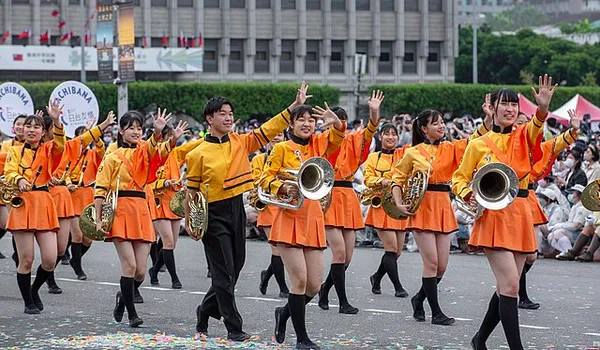
On October 10, 2022, Kyoto Tachibana High School put on a spectacular performance at the Taiwan Double Ten Festival. Taiwan's presidential election will be held on January 13th of this year. In Taiwan, voting rights will be lowered to 18 years or older in March 2022. This will be an event that anticipates the presidential election. The Taiwanese students who were high school students at the time were probably over 18 years old.
democratic election interference
In that sense, this is former Prime Minister Abe's intervention in Taiwan. This is a strategy to fully appeal to the younger generation by emphasizing the exchange of democratic values. Ever since the Biden administration announced its commitment to maintaining the "One China Policy," I have personally viewed Japan's democratic intervention in Taiwan from this perspective. The Biden administration's policy has been to maintain its long-standing "one China policy" and simply order China to speak with democratically elected representatives in Taiwan. In other words, the issue at this point will be Taiwan's presidential election in 2024.
Taiwanese diplomacy inherited
Unfortunately, this event took place during the Kishida administration after former Prime Minister Abe was assassinated. Former Prime Minister Yoshihide Suga referred to Taiwan as a "country" during a party leader debate. At the opening ceremony of the Tokyo Olympics, NHK, which is said to be pro-China, announced "Taiwan" instead of Chinese Taipei. Representative Takaichi held a remote meeting with President Tsai Ing-wen during the presidential election. These things have been widely reported in Taiwan. Unfortunately, the Kishida administration has not made any major moves since the ``Orange Devil'' performance, and on the contrary, it appears to have focused solely on currying favor with Xi Jinping.
Read it together
Why did President Tsai Ing - wen invite Kyoto Tachibana High School to the Double Ten Festival? - Taiwan's future entrusted to future generations.
Kyoto Tachibana High School where Taiwan was crazy
Japan's national defense and the Taiwan Strait issue are inseparable
Taiwan's democratization is a recent event
Danger of being swallowed up by China in the next election
Japan should convey the value of democracy
Regarding why Kyoto Tachibana High School's brass band (Orange Devil) was invited to Taiwan's National Foundation Day ceremony, President Tsai Ing-wen looked ahead to the presidential election in 2024 and asked the next generation who will have the right to vote at that time. It appears that Kyoto Tachibana High School was entrusted with a strong message. In the last presidential election in Taiwan, President Tsai Ing-wen came from behind to win despite being at an overwhelming disadvantage. The Taiwan Democratic Progressive Party itself analyzes that the reason for this is that young people are heading to the polls. It is said that the younger generation in Taiwan is starting to develop a sense of democratic values.
Japan should think more seriously about its national defense. There is no objection to considering the Taiwan Strait as an issue that is inseparable from Japan's national defense. What is needed to achieve this is strengthening Japan-US relations and discussing constitutional revision. But is that enough?
Taiwan's democratization began with the direct election of the president in 1996. It was written by former President Lee Teng-hui, who passed away recently. Has Taiwan followed the path of democratization smoothly since then? The first summit meeting between China and Taiwan was held under former President Ma Ying-jeou before President Tsai Ing-wen. There, former President Ma Ying-jeou and Xi Jinping held a meeting, reaffirming the 92 joint formula and returning to the one-China principle. That was in 2015.
Although Taiwan is a young democratic country, it is on the verge of strong growth. If the Democratic Progressive Party loses in the 2024 presidential election, Taiwan, one of the few democratic countries in Asia, may never smile again. Xi Jinping will try to intervene in Taiwan's presidential election in every possible way.
Kyoto Tachibana High School showed that there are many things Japan can do. Our goal is to show young Taiwanese through a variety of content that on the path to democracy there is a world where free people can realize their dreams. Taiwan considers Japan to be its democratic predecessor. The Japanese media, which should be primarily responsible for this, seems to be controlled by China.
China continues to intimidate
And the presidential election is just over a week away. China has been carrying out various intimidation and threats in the run-up to the Taiwan presidential election. The threat is that if China invades Taiwan, you young people will be the ones fighting on the battlefield. This is the Chinese Communist Party's reasoning. The Taiwan Strait is a sea lane through which oil tankers from the Middle East, which is Japan's lifeline, pass. If the Kuomintang wins, China will gain control of the Taiwan Strait. What has the Kishida administration done about this?
I'm participating in the ranking.Please click and cheer for me.
Democratic Progressive Party Lai Qingtoku wins Taiwan presidential election | If pro - China forces win, the Taiwan Strait will become China's property.
With the Democratic Progressive Party's victory, how does President Xi Jinping view the results in China? The result was an overwhelming victory for Taiwan's independence force, the Democratic Progressive Party. Looking at the Taiwanese parliament, the Kuomintang has made a comeback, giving the impression that the Taiwanese people have given orders to the Democratic Progressive Party when it comes to domestic policy. The Kuomintang has 52 seats, the Democratic Party has 51, and the People's Party has 8. The Taiwanese people are no longer pro-China as a national polity, and perhaps because they have doubts about domestic politics, looking at the number of seats, it seems likely that the People's Party will hold the casting board when it comes to legislation.
In the first place, the victory of the pro-independence Democratic Party in the presidential election can be said to be a major achievement. The Taiwanese People's Party was viewed as a force that could divide votes. The Democratic People's Party's position is that it maintains peace through dialogue with both China and the United States, but to be clear, the Taiwan issue is not connected to the US-China conflict, but is rather an issue within the US-China conflict. The reality is that Taiwan exists in China, and on the other hand, I don't think Taiwan can act as a bridge between China and the United States.
Looking at the theme of war from a different perspective, this election was a fight between the Kuomintang and the People's Party to avoid war, and the Democratic Party to protect democracy even in the event of war. This is probably the correct answer. It is said that the decisions of young people will have a large impact on the outcome of this election, just like the last one, and the voting age will be lowered to 18 in 2023. Taking note of this, the Chinese Communist Party has been threatening you, saying that in the event of war, you, the young people, will be the ones who die.
The focus of this election was on what kind of decisions young people would make amidst this intimidation and coaxing. The Democratic Progressive Party's theme was ``choosing between dictatorship and democracy.'' As a result, table splitting fails in the opposite direction. If the theme is war, if you add up the factions that advocated war avoidance, that side will be the majority. Of course, the issue of China was not the only theme in the presidential election, but in the end, the Democratic Progressive Party won, with the votes split among those calling for war avoidance and reconciliation with China.
It goes without saying that Japan would prefer a victory for the Democratic Party. I have nothing but doubts about the Japanese media, which has not shown much interest in the Taiwanese election even though it says that the Taiwanese emergency is a Japanese emergency. A lieutenant general from a Chinese military think tank recently said that the Senkaku Islands are also on the horizon for an invasion of Taiwan, and if the pro-China faction wins the election, China will control the Taiwan Strait, an area through which oil tankers, Japan's lifeline, pass. This is because it suppresses the If that happens, Japan will continue to be threatened by China semi-permanently.
Taiwan buys evaporated milk from Lithuania, which was rejected by China. Taiwan's feelings for liberalism are real.
It was revealed on the 10th that a Taiwanese food maker bought evaporated milk from Lithuania, which was refused to be received from China. With the cooperation of the governments of Taiwan and Lithuania, about 1,000 boxes have already arrived in Taiwan . A spokesman for the Ministry of Foreign Affairs, Joanne Ou, announced on the 11th that he would continue to cooperate in expanding sales channels for Lithuanian products in Taiwan.
Since the establishment of Taiwan's representative agency "Taiwanese Representative Office in Lithuania" in Vilnius, the capital of Lithuania, Lithuania has been retaliated by China. China has announced that it will downgrade its diplomatic relations with Lithuania to "Chargé d'Affaires", and is increasing pressure by stalling Lithuanian products exported to China at customs clearance.
Lithuania was forced to close the Lithuanian embassy in China by establishing a Taiwan representative office.
Evaporated milk was purchased by Amada Food Technology (Hsinchu County). The amount is as much as one container. The person in charge of the company told the Central News Agency that he would make Hong Kong-style milk tea from the purchased evaporated milk and sell it to the world. The person in charge is a Hong Konger who has lived in Taiwan for more than 30 years, and when he combined Evaporated milk from Lithuania and blended tea from Sri Lanka, he said that a "nostalgic taste" was created.
The developed Hong Kong-style milk tea will be packaged in a design that incorporates the Lithuanian flag "yellow, green, red". At the same time as symbolizing Lithuania's support for Taiwan, it also wants to express the company's support for Lithuania.
Lithuanian friendship with Taiwan has been forced to close the Lithuanian embassy in China. Taiwan will deepen its friendship with Lithuania.
Mr. Xi Jinping believes that Taiwan's independence is the trigger for his invasion of Taiwan - The timing of Taiwan's independence and the influence of elections in each country.
The term of office of the Chinese president is five years. In 2018, China's National People's Congress lifted the 10-year limit for two terms, making it possible for candidates to be re-elected as many times as they like. Xi Jinping is currently in his second term, and his term ends in 2023. Regarding the timing, if any, of China's invasion of Taiwan, in January 2021, the Chinese Minister of Defense made in-depth statements that Taiwan's independence would mean war. At the recent U.S.-China summit, Xi Jinping said, ``If Taiwan's independence forces cross the line, we will take decisive measures.''
In other words, the timing is Taiwan's independence. So, regardless of what kind of action or state one considers independence, Taiwan satisfies all the substantive requirements for becoming a state under international law. All that remains is to draft a declaration of independence and declare it to the international community as an independent country. The question is at what timing it will be done.
Regarding this, President Tsai Ing-wen has stated that Taiwan is "already independent," indicating that she has no intention of drafting a declaration of independence. Taiwan's 2024 presidential election will be held the year after Xi Jinping begins his third term. The Democratic Progressive Party candidates advocate Taiwan's independence, which means that Taiwan is not yet independent, which is a very different nuance from President Tsai Ing-wen's ``already independent'' statement.
If the Democratic Progressive Party candidate becomes Taiwan's president in 2024, there is a high possibility that he will draft a declaration of independence during his term. Xi Jinping, aiming for a third term, will support the Kuomintang, the opposition force to Taiwan's ruling party, and seek to become Taiwan's president. Obsessed with elections. The Nationalist Party is a pro-China party. 2024 is also the year of the US presidential election. Based on President Tsai Ing-wen's idea that the country is "already independent," it is unlikely that a declaration of independence will be drafted under the Tsai Ing-wen administration or the Biden administration.
Taiwan's presidential election and the US presidential election will begin in 2024, and Xi Jinping's third term will begin in 2023. It will be interesting to see if there is any movement after this time.
Since the term of office of Taiwan's president is four years, the term of office of the next president will expire in 2028, which will be Xi Jinping's fourth term. Xi Jinping will need to see results by at least 2027 to be re-elected to a fourth term. This timing is the 6th year that Commander Davidson said that war would occur within 6 years. If the US Republican Party wins in 2024, the situation will change dramatically.
The timing of Taiwan's declaration of independence may have a great deal to do with the elections in the three countries.
It is said that Japan occupaied the Korean Peninsula as an important location.Which country is not an important place?
If Japan claims that the Korean Peninsula was independent due to the Quins-Japanese War, Japan may have gained independence from the Korean Peninsula, but the Korean people objected that it was only a key location.It's amazing to hear this all the time.I think every country is an important point of some country, but is it different?Supporting independence as an important point is also taking place in the world today.What are the problems in Taiwan, Hong Kong, and Myanmar?
Even if there is a common denominator of democracy, the military elements are indivisible.On the contrary, if there are no military factors, will other countries strengthen their armed forces?During the Great East Asian War, Japan considered all Asian countries important and expelled white countries for Asian independence.Asian countries are weak, but they want to unite and escape white rule.Are you saying you've used all of this?
If China suddenly invades Taiwan, the United States may send U.S. troops to defend Taiwan.Then there will be war.What would happen if the U.S. had killed its own people and defended Taiwan, but Taiwan's internal forces had betrayed Tsai Ing-wen's forces and approached China?The United States may abandon Taiwan or rule it.President Tsai understands the interests of each country and tries to stick to the ideology of democracy, regardless of whether it is an important place or not.
Korea, which is independent but has a backward democratic ideology, is in stark contrast to Taiwan, which is trying to protect democracy and become independent.
The Chinese Communist Party's economic takeover - dependence on the Chinese economy is the same as being taken over - young people with no vested interests are the key.
Xi Jinping's strategy
Will peaceful dialogue be possible
Reach for any target
Taiwan was one step away from unification
At the 110th Anniversary of the Xinhai Revolution, President Xi Jinping cited the "One China" principle and the "1992 Consensus" based on it, and stated that the two countries would "promote the peaceful development of cross-strait relations." This is a worrisome statement, considering that he will never do the right thing in terms of Taiwan policy. On October 4, a record 56 Chinese aircraft entered Taiwan's airspace. Since the beginning of October, there have been a total of 149 airspace intrusions, but by the 5th, this had dropped sharply to just one aircraft.
Biden has called for peaceful dialogue with democratically elected leaders, but the issue remains focused on Taiwan's next presidential election. If Taiwan's next president becomes pro-China and moves toward unification with China, the United States will not interfere as long as the conclusion is reached through peaceful dialogue. It also means.
Direct bribery of politicians seems like something out of a TV drama, but China's strategy is much more elaborate. Communist Party members are reaching out to politicians' families, relatives, friends, politicians' support bases, and organizations.
If politicians' supporters were given huge amounts of wealth through business with China, they would easily turn over, and they would sniff out cheating, traffic accidents, tax evasion, minor legal violations, etc. of the politicians themselves and those around them. Collect information. To do this, they will use all sorts of methods, including hacking and wiretapping communication devices, and installing mechanisms to send information to the Chinese Communist Party into the communication devices themselves.
Before President Tsai Ing-wen, the era of President Ma Ying-jeou was one step closer to unification. Young people's votes played a key role in President Tsai Ing-wen's re-election. The key to the next election will be how to encourage young people, who have fewer business interests and other interests, to vote.