Will Miss. Chou Ting's message reach Taiwanese youth? - What is the ripple effect of his declaration of asylum in Canada?
2024-01-03
Category:Taiwan I'm participating in the ranking.Please click and cheer for me.
Miss. Chou Ting intends to seek asylum in Canada
After Miss. Chou Ting announced his intention to seek asylum in Canada, Hong Kong police said they would do everything in their power to arrest him since the December 29 deadline for his return to the country had passed. Mr. Shuba also mentioned the existence of secret police and the danger of being targeted by spies. He went to Canada to study abroad in September 2023.
One of the leaders of the Hong Kong protests
The Hong Kong protests are said to have been triggered by China's National People's Congress's decision in 2014 to restrict the number of candidates for the post of chief executive of Hong Kong. At this time, a large demonstration occurred and was also called the Umbrella Movement. Since then, demonstrations against the enactment of the Fugitive Offenders Act and the National Security Act have continued to grow in scale and have been reported around the world. Mr. Shutei is considered to be one of the central figures.
Collapse of one country, two systems
The enactment of these laws will be seen as a de facto collapse of one country, two systems, and investment in Hong Kong from various countries will be withdrawn one after another, accelerating China's current isolation. Mr. Shuba was subsequently arrested and detained, but the charges were relatively light and he was sentenced to 10 months in prison, although he was actually released after about 6 months.
A placating measure by the Chinese government?
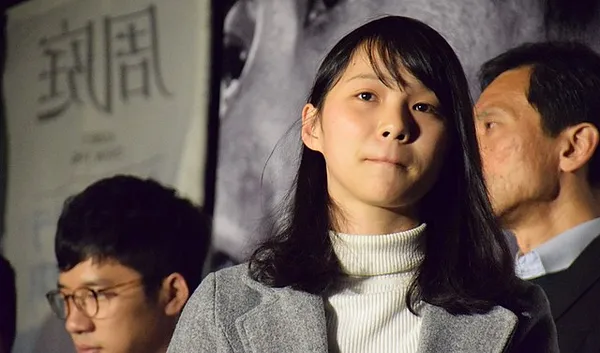
It appeared to be an attempt by the Chinese government to suppress the demonstrations and appease the ringleaders. I wonder if it means that they don't want to provoke the students any more, or they don't want to provoke other countries, but what happened after that was Mr. Shuba's study abroad. I was honestly surprised by this as well. I wonder if a person who incited the people and caused a large-scale demonstration in China could study abroad.This seems like a placating measure, but I imagine that Taiwan could be an extension of this.
#img2#
Hong Kong protests spread to Taiwan
It is said that students from the Sunflower Movement in Taiwan taught Hong Kong students how to demonstrate. This led to large-scale demonstrations in Hong Kong, and the enthusiasm returned to Taiwan, leading to a dramatic come-from-behind victory in Taiwan's presidential election in 2017 for Tsai Ing-wen, who was said to be at a disadvantage. Taiwan will become the next Hong Kong. The younger generation's sense of crisis about the end of Taiwan's democracy had a major impact on electoral behavior. If the spark was smoldering in Hong Kong, it could once again influence Taiwan's elections. On the other hand, the fact that Mr. Zhou Ting is able to study abroad in Canada freely could be used to appeal to young Taiwanese people.
News coming back to Taiwan
This is a de facto declaration of asylum at this timing. The timing of the Taiwan presidential election was probably decided to be at the end of this year because it was held on December 3rd, Miss. Chou Ting's birthday, and the deadline for returning to Japan was December 29th. is January 13, 2024. If the Chinese government had been aiming for a placating policy, the message that Mr. Zhouting's life was in danger was the complete opposite, and the news was sure to reach Taiwan as well. The goddess of democracy is alive and well.
I'm participating in the ranking.Please click and cheer for me.
Will the Japan - Taiwan exchange held by Kyoto Tachibana High School have an impact on the presidential election? - Impact on Taiwanese democracy since the Abe administration
On October 10, 2022, Kyoto Tachibana High School put on a spectacular performance at the Taiwan Double Ten Festival. Taiwan's presidential election will be held on January 13th of this year. In Taiwan, voting rights will be lowered to 18 years or older in March 2022. This will be an event that anticipates the presidential election. The Taiwanese students who were high school students at the time were probably over 18 years old.
In that sense, this is former Prime Minister Abe's intervention in Taiwan. This is a strategy to fully appeal to the younger generation by emphasizing the exchange of democratic values. Ever since the Biden administration announced its commitment to maintaining the "One China Policy," I have personally viewed Japan's democratic intervention in Taiwan from this perspective. The Biden administration's policy has been to maintain its long-standing "one China policy" and simply order China to speak with democratically elected representatives in Taiwan. In other words, the issue at this point will be Taiwan's presidential election in 2024.
Unfortunately, this event took place during the Kishida administration after former Prime Minister Abe was assassinated. Former Prime Minister Yoshihide Suga referred to Taiwan as a "country" during a party leader debate. At the opening ceremony of the Tokyo Olympics, NHK, which is said to be pro-China, announced "Taiwan" instead of Chinese Taipei. Representative Takaichi held a remote meeting with President Tsai Ing-wen during the presidential election. These things have been widely reported in Taiwan. Unfortunately, the Kishida administration has not made any major moves since the ``Orange Devil'' performance, and on the contrary, it appears to have focused solely on currying favor with Xi Jinping.
And the presidential election is just over a week away. China has been carrying out various intimidation and threats in the run-up to the Taiwan presidential election. The threat is that if China invades Taiwan, you young people will be the ones fighting on the battlefield. This is the Chinese Communist Party's reasoning. The Taiwan Strait is a sea lane through which oil tankers from the Middle East, which is Japan's lifeline, pass. If the Kuomintang wins, China will gain control of the Taiwan Strait. What has the Kishida administration done about this?
Will Taiwan Become a Key Hole in China's
The Tiananmen Square incident will be remembered as China's democratization movement.Even tanks were deployed to eliminate the movement to democratize students and young people.Next is the Hong Kong demonstration.China has consistently reported this as violent behavior.
The Tiananmen Square incident was suppressed by the Communist Party of China, which feared the pro-democracy movement would spread all over the country.The Hong Kong demonstration was also threatened by the enactment of a national security law and armed intervention from the mainland.In Chinese, the demonstration is called a demonstration parade, and it uses Chinese characters meaning marching while demonstrating its power.If the demonstrations are tolerated and the pro-democracy movement is successful, China will fall apart and disintegrate in the air.
The Hong Kong demonstration has been reported as an incident in which rioters were suppressed in China.If Taiwan becomes independent, the shock in China will be immeasurable.
I think Taiwan and China are different countries, but they are different in China.Taiwan is recognized as part of China.Taiwan's independence means that China's one country, two systems, such as Hong Kong and Macau, will become independent.The impact of this incident on China is expected to be enormous.Considering the impact of Taiwan's independence on other ethnic areas and autonomous regions, the Chinese government is on high alert.Uighur and Tibet are China's resource areas.If foreigners leave China, it will be a serious blow to China's economy.
The Chinese think face is important.If you lose your face, you'll blush and get angry.The territorial issue is a disgrace to China.In response to Chiang Kai-shek's attempt to resolve the Rohgyo Bridge incident peacefully with Japan, Mao Zedong criticized it as a weak stance and advertised it to the people and entered the Sino-Japanese War.In response to Japan's nationalization of the Senkaku Islands, Xi criticized former President Hu Jintao for trying to settle the matter peacefully and withdrew him from his post.For China, the loss of territory or independence is a great loss to the face of the Communist Party government.Xi's obsession with Taiwan is immeasurable.
In addition to Taiwan, China also has areas that sing one country, two systems, including Hong Kong and Macau, and autonomous regions such as Inner Mongolia, Guangxi Chihuang, Tibet, Xinjiang Uighur, and Ningxiahui.
Is the orange devil that is so popular in Taiwan a brilliant strategy of President Tsai Ing - wen? Japan should also learn from Taiwan.
Orange devil is very popular in Taiwan
Free youth is a symbol of democracy
Shocking dignified high school student
Are you considering lowering the voting age?
It seems that the Kyoto Tachibana High School boom in Taiwan has not subsided yet. Japanese high school students, known as the ``orange devils,'' were invited to Taiwan's Double Ten Festival and gave a spectacular performance to appeal for friendship between Japan and Taiwan.
The Double Ten Festival is a ceremony that celebrates Taiwan's National Foundation Day, and it is unusual for a high school student from a foreign country to appear as the main event. What's more, there was even a surprise appearance by President Tsai Ing-wen during the tour of the Presidential Palace. In Taiwan, Japan is a senior country in liberal democracy, and as we were once the same country for 50 years, there is a lot of interest in Japan.
It appears that this ``orange devil'' was invited to the ceremony as a symbol of liberal democracy. In other words, this is an excellent performance by the Tsai Ing-wen administration. In the 2024 presidential election, Taiwanese people will choose a national ideology. It is not an election about which side will be economically richer, but a choice between liberal democracy and Chinese-style socialism.
What the young people of Taiwan saw was a marching band, which is just a part of a high school club activity, displaying overwhelming musical ability, and proudly performing at a ceremony attended by the president of another country. Taiwanese people seemed surprised by this. The question is whether it will be a liberal democracy where talent flourishes freely or a socialism that is embraced by Xi Jinping's plump belly.
The lowering of the voting age in Taiwan to 18 years old in March 2022 also has a lot to do with this. Taiwanese high school students of the same generation as the Orange Devil will head to the polls in 2024. The fact that it has become so popular means President Tsai Ing-wen's production was a great success. President Tsai Ing-wen is much smarter than Xi Jinping. By the way, if you paste a video related to the "Orange Devil" in Taiwan on Facebook, it will be deleted as a violation of the community rules. I don't know much about the relationship between the Chinese Communist Party and Facebook, but it seems certain that it's not a good fit.
Chinese Spring Festival delega Xi Jinping did not hide his ambition even though he had no track record, and his OBOR, which he pushed for, ended in failure and is now trying to be contained by other countries.Why is it that the Constitution has been revised to become president for life and there are no signs of his downfall?Xi Jinping criticized Hu Jintao, who tried to settle the Senkaku Islands peacefully with Japan, and led the anti-Japanese riot.As the riots overheated and the people were about to attack the regime, Hu Jintao hurriedly suppressed them.This is similar to Mao's strategy of going to Chiang Kai-shek.
Zhou Yongkang, China's former political enemy, was excluded in the name of eradicating corruption.Dongguan, known as the capital of China's sex, colluded with the police and led by Zhou Yongkang.In China, this is a natural collusion, but for this reason it was dragged down and excluded.In this way, Hu Jintao's faction was buried one after another.Even now, Xi's loud cry is to eradicate corruption.It's good to hear what Xi says, but that's what Xi Jinping is doing.The current head of the public security department is known to be responsible for almost all corruption and corruption.
In China, children with high athletic ability will be transferred to places where they will receive gifted education as athletes of the future national sports team.The same is true of the Communist Party.It is an honor to be selected as a class committee member at a Chinese school.It is the first major gateway to becoming a member of the Communist Party of the future.
The only thing the Chinese put before the state is their clan.If a good child is born, the clan will support him, and if the child becomes a member of the Communist Party, the clan will be rewarded.If you lose your position in the pursuit of corruption, there will be many sects behind you.Xi Jinping, who is advocating eradication of corruption, is slowly closing his eyes and using it to control people's minds.
It is said that the only scenario for Xi's downfall is assassination.Xi Jinping seems to be very wary of this.This is a group photo of the Spring Festival party held on February 20, 2021.Everyone is applauding the camera all at once, but several people are facing the other way around.This is the Great Hall of the People where I'm sure you only have your firiends isn't it?
The Chinese Communist Party's economic takeover - dependence on the Chinese economy is the same as being taken over - young people with no vested interests are the key.
Xi Jinping's strategy
Will peaceful dialogue be possible
Reach for any target
Taiwan was one step away from unification
At the 110th Anniversary of the Xinhai Revolution, President Xi Jinping cited the "One China" principle and the "1992 Consensus" based on it, and stated that the two countries would "promote the peaceful development of cross-strait relations." This is a worrisome statement, considering that he will never do the right thing in terms of Taiwan policy. On October 4, a record 56 Chinese aircraft entered Taiwan's airspace. Since the beginning of October, there have been a total of 149 airspace intrusions, but by the 5th, this had dropped sharply to just one aircraft.
Biden has called for peaceful dialogue with democratically elected leaders, but the issue remains focused on Taiwan's next presidential election. If Taiwan's next president becomes pro-China and moves toward unification with China, the United States will not interfere as long as the conclusion is reached through peaceful dialogue. It also means.
Direct bribery of politicians seems like something out of a TV drama, but China's strategy is much more elaborate. Communist Party members are reaching out to politicians' families, relatives, friends, politicians' support bases, and organizations.
If politicians' supporters were given huge amounts of wealth through business with China, they would easily turn over, and they would sniff out cheating, traffic accidents, tax evasion, minor legal violations, etc. of the politicians themselves and those around them. Collect information. To do this, they will use all sorts of methods, including hacking and wiretapping communication devices, and installing mechanisms to send information to the Chinese Communist Party into the communication devices themselves.
Before President Tsai Ing-wen, the era of President Ma Ying-jeou was one step closer to unification. Young people's votes played a key role in President Tsai Ing-wen's re-election. The key to the next election will be how to encourage young people, who have fewer business interests and other interests, to vote.