The Taiwanese emergency is a Senkaku emergency - Chinese military lieutenant general who did not deny the argument shifts responsibility by saying that it is up to Taiwan.
2023-12-29
Category:China I'm participating in the ranking.Please click and cheer for me.
Statement by Lieutenant General of Chinese military think tank
By the 9th, He Lei, former vice president (lieutenant general) of the Academy of Military Sciences, a Chinese military think tank, gave an exclusive interview to Kyodo News and clarified that he ``doesn't want war, but I'm not afraid of it'' regarding the Senkaku Islands in Okinawa Prefecture. Personally, I am concerned about this statement by the lieutenant general.When I asked him about the possibility of unifying Taiwan and seizing the Senkakus at the same time based on China's claim that the Senkakus are part of the "Taiwan Province," he replied, "It is not logical. If you do that, then yes,” he said without denying it.
Senkaku issue shelved
Taiwan was the first to claim sovereignty over Uotsuri Island. Since Taiwan was in June 1971 and China was in September of the same year, it appears that China hastily raised its hand to the international community three months later. During this period, a dispute over the representative government was being held at the United Nations, and the United Nations Resolution on Albania was adopted in October 1971, which established the People's Republic of China as the representative government of China. In response to this, Japan established diplomatic relations with China in 1972, but it is said that there was an agreement to shelve the issue of the Senkaku Islands so that it would not become an issue by not making it an issue.
Violation of territorial waters started with nationalization
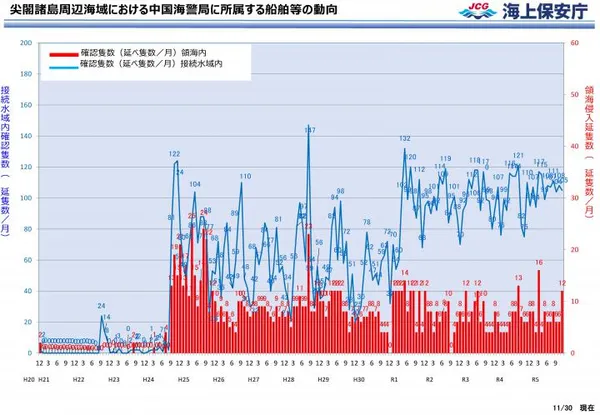
The graph shown shows the number of territorial sea violations by China, and it can be seen that there were almost no cases up until 2012. It began with the nationalization of the Senkaku Islands by the Noda administration in September 2012. In other words, China's reasoning is that Japan has made an issue that had been shelved. They argue that for this reason, China will also openly make territorial claims. Before that, it is Japanese territory in the first place.
#img2#
The Noda administration could not withstand criticism and nationalized the country.
The circumstances surrounding this nationalization by the Noda administration were so pathetic that they released the captain of a Chinese fishing boat that rammed the Japan Coast Guard for unknown reasons, and were unable to withstand public criticism. At the time, Governor Tanigaki argued that if he was going to be released, he should have just deported him on the spot instead of arresting him in the first place.
Read it together
Under the United Nations resolution on Albania, China's representative government becomes the People's Republic of China - national representation as a permanent member of the United Nations Security
National representation rights claimed by both sides
Taiwan withdraws from the United Nations as a result of this resolution
Japan and the US tried to prevent Taiwan's expulsion from the UN
Taiwan is just a common name
US supports Taiwan's membership in international organizations
China expands interpretation of Albania resolution
The issue of one China began when the Republic of China (Taiwan) and the People's Republic of China fought over the right to represent China as a permanent member of the United Nations at the United Nations following a civil war. At that time, the Republic of China was a member of the United Nations as a permanent member of the United Nations.
As a result of the 1971 Albania Resolution recognizing the People's Republic of China as the representative member state of the United Nations, the Republic of China withdrew from the United Nations. In advance, Japan and the United States tried to persuade Taiwan to voluntarily decline the right to represent China, but Chiang Kai-shek was not convinced.
One China claimed not only China but also Taiwan. Taiwan was the first to claim the Senkaku Islands before China.
In response to the Albania resolution, the United States proposed a dual representation resolution and Japan proposed an important issue resolution against expulsion to the United Nations. As a result, the Albania Resolution was passed, and the People's Republic of China was to take over the power of representation, eliminating Taiwan's seat.
The problem might have been different if Taiwan had withdrawn its representation rights and applied for recognition as a separate country at the same time.
What we now call Taiwan is not the official name of the country; its official name is the Republic of China. Taiwan is a common name that means the name of the region. At the Olympic Games, it was called Chinese Taipei, and Japan's NHK called it Tiwan, which became a hot topic, but the country's name itself is internationally connected to the United Nations issue.
Based on the above circumstances, the United Nations has simply recognized the People's Republic of China as the representative government of China, and since the Republic of China has withdrawn from the United Nations, this does not mean that the United Nations does not recognize the country.
The United States has said it will support Taiwan's participation in international organizations. U.S. Republican Rep. Jim Risch said that China is expanding the interpretation of the Albania resolution.
Conversely, the basis for China's insistence on excluding Taiwan from the international community is the 1971 Albania resolution.
The United States has criticized China for abusing the Albania resolution by expanding its interpretation. China is pressuring other countries to prevent Taiwan from participating in international organizations.
Senkaku Islands linked to Taiwan
A statement by a lieutenant general from a Chinese military think tank places the Senkakus as Taiwan's responsibility. If the one country, two systems principle is followed, Senkaku will become Taiwan. Xi Jinping has repeatedly stated that Taiwan's independence is a trigger for an invasion of Taiwan.
Argument for entrusting the Senkaku issue to Taiwan
The Taiwan emergency included the Senkaku issue within the Japan emergency, and there were many questions about how the Japan-U.S. Security Treaty would be activated if China publicly stated that it would maintain navigation through the Taiwan Strait and there was no attack on the Senkaku Islands. This time, China has publicly stated that the Senkaku Islands are part of it. In other words, the only objective is the small island of Senkaku, which is part of Taiwanese territory, and the question is whether the United States will participate in the war just for this island.
The Japanese side responded to this request.
Now that China has made it clear that it will extend its reach to the Senkaku Islands in the event of a Taiwanese emergency, how will the Japanese government respond? Would you go and rent even 10 pandas? My thinking is almost the same as that student who yelled at the SEALDs meeting that I would drink alcohol and become better friends with him.
I'm participating in the ranking.Please click and cheer for me.
Korea has the largest ODA per population.China Appreciates Japan's Economic Aid
According to Japan's Ministry of Foreign Affairs, ODA to China totaled about 3.9 trillion yen from 1979 to 2016.More than 60% of China's foreign aid is from Japan.Shanghai Pudong International Airport, Beijing Capital International Airport, Lanzhou, Wuhan, and Xi'an airports were also built with Japanese aid.In addition, 5,200 kilometers of railways, Beijing sewage treatment plants, Sino-Japanese Friendship Hospital, Beijing Subway, Chongqing Railway, and major ports have been built and expanded.
Since the 2000s, JICA has been training more than 15,000 managers and HIDA has been training more than 22,000.Former General Secretary Deng Xiaoping and former General Secretary Hu Jintao officially thanked each other.Recently, Deputy Spokesman Hua Chunying thanked Japan, saying, "Japan's ODA has contributed greatly to China's reform and opening-up and economic development," adding, "We will discuss new cooperative relations with Japan."
Although there are territorial issues in Sino-Japanese relations, the Chinese government officially acknowledges that Japan has contributed greatly to China's development.
The amount of ODA to South Korea is 650.2 billion yen, but the total value of $500 million, including free financial cooperation and private cooperation, is said to be 2-3 trillion yen.Compared to China, South Korea has the most aid in terms of ODA costs per population.
Japan apologized to South Korea several times during the annexation of South Korea and Japan, but South Korea did not remember.I don't think Japan remembers being thanked by South Korea, but this is more true.On the contrary, after the end of ODA program for South Korea in 1990, the problem of recruiting workers and Japanese Military comfort woman grew.Is it just my imagination that they seem to have started after end of ODA.
Since the end of ODA to South Korea, the anti-Japanese movement in South Korea has become popular.Is this a coincidence?
The acquisition of African countries by the world's underground financial institution AIIB is China's national strategy.
AIIB is the world's black finance. Lending money to developing countries to realize OBOR. They provide funds that cannot be repaid, and when they are unable to repay, they seize the country's ports and other facilities. If OBOR is realized, the countries in the area will become rich. That's why it's better to borrow more and more money.
With this financing, China bought up votes in the United Nations, including African countries.
Originally, the African continent was divided into two colonies, British and French, and the British Commonwealth and French Community held the vote in the United Nations, but what is the situation like now? OBOR is China's national takeover strategy.
Communism views capitalists and managers as enemies. Workers become subordinate to capital, and capitalists who acquire large amounts of capital become figures that shake up the nation. Therefore, Chinese companies are controlled by the state as state-owned or semi-state-owned.
In modern China, the state is the capitalist. They invest in domestic and international development in the name of investing in the region and the nation.
If you look at the fact that they are subjugating developing countries to capital, they are essentially no different from the capitalists they see as their enemies.
In fact, it's even worse.
China puts aside domestic environmental issues and bans imports from Fukushima.
I was wondering why the average life expectancy of the Chinese people is so short.China is the birthplace of traditional Chinese medicine and is a country that practices the same principle of medicine and food, but why is there a difference of nearly 7 to 8 years with Japan? There used to be a difference of about 10 years. I thought it was because Chinese cuisine basically uses a lot of oil, but that alone doesn't explain it.
There was a story that when an air dosimeter was used to measure air dosimetry in an apartment in Shanghai, it was 976 times as high as in Tokyo.However, since radioactivity from land comes from mineral resources, it is important to note that radioactivity from land is emitted from mineral resources, so it is important to note that radioactivity from land is emitted from mineral resources. The higher the radiation dose, the higher the radiation dose. Plutonium is extracted from uranium ore, and there are many other ores that contain high amounts of radioactive materials in nature.
It has long been known that rare metals made in China are traded internationally at low prices because China does not provide the various health considerations and guarantees that each country naturally takes into account. This is natural since this is a country where there is no sense of human rights. Radioactive materials are generated from rare metals during the mining process. As a result of not paying attention to the miners, radioactive materials flow into the river.
The fine aggregate, or fine sand, used in things like concrete is finely ground by river currents. Nuclear power plants in inland China use river water for cooling water, but it is said that nuclear power plant accidents occur frequently, and since it is a country like that, even if an accident occurs, it is naturally covered up.
As a result, we do not know what is contained in the building materials of condominiums. It is understandable that radioactivity levels were detected in Shanghai crabs taken downstream of the river.
Japan should always talk from a scientific perspective, and if the Chinese had a scientific perspective, would they realize that their country is already in a dire situation? If you still don't notice 30 years from now...
Will Ethiopia's default be the end of African investment? Debt trap derived from One Belt, One Road.
China's One Belt, One Road initiative is set to go even further down the road after Africa's Ethiopia defaulted on the 2nd, unable to pay interest on its debt due in December. The countries circled on the map in the image are the countries where China is primarily investing. Ethiopia, which defaulted this time, is marked in red. One Belt, One Road is a route south to Italy in Europe, but Italy has announced its withdrawal from One Belt, One Road. This is the departure of the western base. Where is Kitaji's base? It is now Kiiv, the capital of Ukraine, which is currently at war.
Yellow countries are those with excessive debt to China. Includes Sudan and Somalia. These are the countries along the Suez Sea, including Ethiopia, which follow the Suez Canal, and China was trying to gain control of the sea route to the Mediterranean Sea. The rationale is simple: once the One Belt, One Road project starts, we can make a lot of money, so why not borrow money and prepare?
South Africa has the highest GDP among African economies, and it can be seen that the countries on the land route to South Africa are also trying to keep it in check. Countries other than the ones circled account for 36.9% of China's investments in Africa, so it is spreading money to almost all countries. The purpose is to buy votes from the United Nations. African countries account for approximately 28.5% of the votes in the United Nations. This is what is behind China and the West, dismissing it as a minority opinion.
This is actually related to the Taiwan Strait issue. Mainly African countries support China's "one China principle." Africa does not want to get into trouble with its creditor country, China, over a faraway island with which they do not have any exchanges.
If the countries along the Suez Sea default, the Belt and Road initiative will end for Africa.
Can China's encirclement aim to divide China? - Cut off tax revenue for the increasingly obese Chinese Communist Party.
What is the population of China
Revival of the issue of national self-determination
Can China's autonomous regions become independent
China creates its own concept of ethnicity and promotes Hanization policy
The Uighur issue spreads to other autonomous regions
China became a Jain nation
China's weakness is its large territory
If Japan, the US, and Europe do not create a network of encirclement of China and seal it off, it will be a disaster
China is said to have a population of 1.4 billion, but the actual population is around 90 million. 90 million people is the number of Communist Party members. Isn't it possible to think of the other 1.3 billion people as workers ruled by the Chinese Communist Party, rather than citizens, assuming democratic values?
The definition of the right to national self-determination has once again become a theme. Russia's invasion of Ukraine also uses this idea as a shield. Going back in time, the Nazis also began invading neighboring countries under the pretext of protecting Germans. On the other hand, it also functioned as the right of Asian countries to become independent from colonial rule, and under international law, independence from colonial rule was an exercise of the legitimate right to self-determination.
China has various autonomous regions, all of which are inhabited by different ethnic groups. Uighur, Tibet, Inner Mongolia Autonomous Region, etc. During a question session in the Japanese Diet about the right to self-determination for the Uyghur Autonomous Region, former Prime Minister Koizumi was ambiguous as to whether the right to self-determination advocated by the United Nations included the right to independence (within a non-colonial state). It cites examples such as the UN's adoption of Palestine's right to independence.
In other words, since this is what China is afraid of, it is eager to implement the Hanification policy. Han people have no relation to bloodline, and have established their own ethnic definition that if you accept Chinese style, culture, and customs, you are a Han ethnic group. On top of that, it is said that they are forcibly brainwashing the Uyghurs, calling them educational facilities.
If the Uighurs were to take up arms and exercise their right to self-determination and start a war of independence, international public opinion would once again be influenced by the United Nations' definition of the right to self-determination. Depending on the outcome, there is a strong possibility that this will spread to Tibet, Inner Mongolia, Zhuang, and other areas. If you add the population of China's autonomous regions, it will be about 100 million people. However, this ethnic area is also an important resource area for China. What would happen if they left? Taiwan is difficult here. It is difficult to say that Taiwan is a separate ethnic group from China.
At the same time, China is causing border problems in all directions. You can do whatever you want in the Spratly Islands. However, the other side of the coin is that China is completely surrounded by surrounding countries and regions that are frustrated with the Chinese Communist Party. The only reason why the surrounding areas are in suspense is because of the threat of China's 1.4 billion people. No. China has 90 million people. What would happen if you thought about it?.
China's military would be weakened if it was dispersed over a wide area. What would happen if other surrounding areas also started border disputes in the event of a Taiwanese emergency? Taiwan is no fun if it only defends Taiwan. Taiwan should take control of Fujian Province. This is to create a buffer zone. The Spratly Islands should be controlled together with the Philippines and Vietnam. Then, they should conquer Yunnan Province and liberate the Zhuang Autonomous Region. This is to create a buffer zone. India will control Kashmir. And we should take control of Sichuan Province. What will happen if Uighurs and Tibet go into a war of independence?
I would like Japan to work with the United States to engage in strategic diplomacy to seriously create a network of encirclement of China. The Chinese Communist Party is a monster that controls 1.3 billion people and siphons off tax revenue. The country receives 13 times more tax revenue than a country with 100 million people and 26 times more than a country with 50 million people, making it bloated. Where in the world is there a political party with 90 million people?
They simply refer to their area of control as a nation; they call it internal affairs. If a conflict were to start in all directions in the surrounding areas, the 1.3 billion people would have no independence in the first place and would be scattered and rendered powerless. The only way to seal this monster away is to divide the country and cut off tax revenue.