In response to the Itaewon Halloween accident in South Korea, President Yoon prioritizes the settlement of the accident as a matter of national policy - The settlement of the accident is a matter of
2022-11-01
Category:South Korea I'm participating in the ranking.Please click and cheer for me.
A barren debate if it comes down to civic consciousness
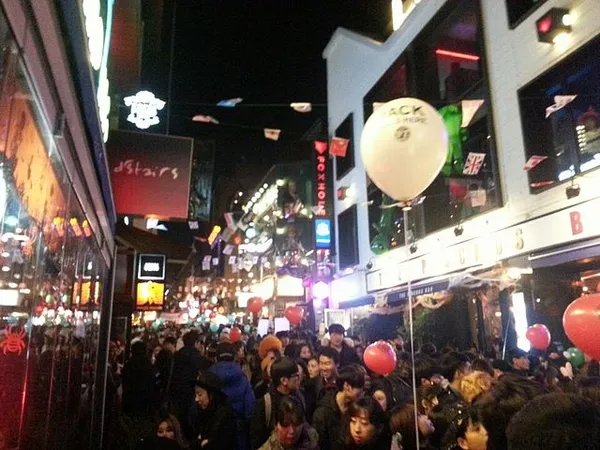
After the Halloween accident in Itaewon, South Korea, there seems to be a lot of public opinion in South Korea. It seems that there are opinions on social media such as ``It's a problem with young people's manners,'' and ``Let's raise citizen awareness.'' There was even an opinion that there was a person who pushed from behind, and that person should be identified. A crowd accident is when everyone is pushed from behind.
The same idea as China will not solve the problem
This is exactly the same as the summary of the Shanghai accident. In the case of the Shanghai Bund accident, the conclusion was to raise public awareness in China. Of course, the issue of public awareness is not irrelevant. If you can't walk in line and keep your turn, it will easily lead to crowd accidents. But how do you explain the mass accident that occurred in Japan, which is said to be the most lined up in the world? No matter how much you raise your awareness, accidents still happen .
Read it together
Death toll from Halloween Shogi chess accident in Seoul rises to 151 - Different countries respond differently to similar accidents.
Deadly accident occurs on Halloween in Seoul
Akashi fireworks festival accident for which police were held responsible
Shanghai accident started with suspicious report
China's return to people's responsibility
How will South Korea sum up this issue
The number of people killed in a shogi accident during Halloween in Seoul has increased to 151. This is the worst accident in terms of man-made disasters. This accident reminds me of the Akashi fireworks festival accident in Japan and the New Year countdown accident on the Shanghai Bund in China. Shogi accidents occur when players are pushed from behind in a crowded crowd, or when they step on someone else's foot and lose their balance. This chain causes a major accident.
This also happened during the Akashi Fireworks Festival, and 11 people died. However, it is impossible for the people who disrupted that arrangement to be held responsible. Problems with the police and security were investigated day after day, and in the end, a civil court ordered Hyogo Prefectural Police and the security company to pay damages. The conclusion is that it was foreseeable and that the necessary measures were not taken. In the criminal trial, one police officer and one security company were sentenced to 2 years and 6 months in prison, and 3 city employees were sentenced to 2 years and 6 months in prison, suspended for 5 years was found guilty.
Next, regarding the incident in Shanghai Bund, I was in Shanghai on the day of the accident. A Chinese person I spoke to the next day asked me, didn't you go to the Bund last night? I found out when I was asked. According to the news reports after the accident, 36 people were said to have died. From then on, it turned out to be a complete lie. On New Year's Eve, Shanghai was in a state of chaos, with people rushing to the point where it was difficult to walk, not only on the Bund, but also everywhere, including the station premises, and it would have been no surprise if an accident occurred anywhere. . If it was an accident during the New Year's countdown on the Bund, it was clear that 36 people would not have been there.
Afterwards, I was looking into how this incident was summarized in China, and came across an article called Expert Opinion. "Increase public awareness of safety, avoid danger, and avoid crowded places." In other words, public responsibility for gathering too much. It was not intended to hold the government or police responsible.
There was clearly a problem with the accident in Seoul, and it was a catastrophe in which many people died. Maybe it's because it happened right after the accident, but when I look at articles from South Korea, there doesn't seem to be any complaints about the lack of police or security. In Japan, a ruling after the accident increased the responsibility of the police and security companies for events where large numbers of people gather, resulting in an increase in the safety of citizens.
Shogi falling accidents occur in various countries, but the way each country views and deals with the problem is completely different. How will South Korea summarize this accident?
Could the accident have been prevented?
Minister of Public Administration and Safety Lee Sang-min appears to have become a controversial issue when he said, “The problem could not have been resolved by deploying police and firefighters in advance.” CNN and the Washington Post seem to point to problems with police security and operations. This is the correct answer. It's clear that the Chief of Administration and Safety himself is not aware of the problem, even after the catastrophe of that magnitude.
There was enough predictability
In the trial for the pedestrian bridge accident at the Akashi Fireworks Festival, the question was whether it was predictable and whether the accident could have been prevented. As for predictability, it was clear to everyone that an event would be held and many people would gather. It is said that the street where the accident happened in Seoul was also a place where many people could easily gather. In other words, it can be said that there was foreseeability .
There was a way to prevent accidents
As for whether or not the accident could have been prevented, the Akashi trial explained the physical mechanism that causes a shogi overthrow. It was proven that 13 to 15 people per square meter were densely packed on the pedestrian bridge. It was also proved that the pressure concentrates on the corners and edges of the passage. In other words, it can be concluded that there is a high possibility that fatal accidents caused by knocking down shogi would not have occurred if, at the very least, less than 5 people per square meter were arranged and spaces were created at both ends of the aisles. Humans don't die from being pushed from behind.
Only the police or security guards assigned to guard the event can direct traffic. On this day, 200 police officers were mobilized in South Korea to guard Halloween, which means the accident was preventable . The method is to secure space at both ends, and once a certain group of people pass through, they will be regulated, and after opening the space, the next group will be allowed to walk.
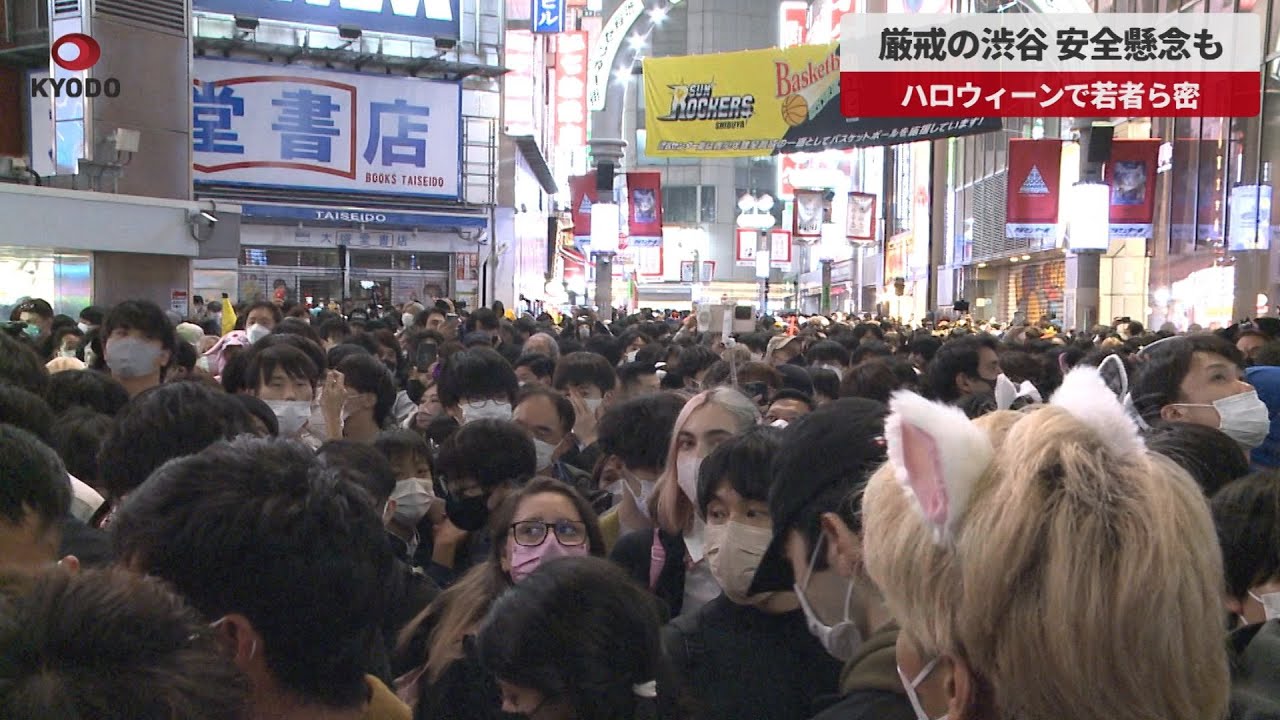
Halloween in Shibuya under police security
120,000 people visited Shibuya at its peak for Halloween last night. Many police officers are conducting walking guidance. On top of a large police vehicle, a police officer makes an announcement over a loudspeaker and gives instructions to pedestrians. This is installed in several places in the shopping district of Shibuya, and it monitors whether there are too many crowds from above and whether there are any troubles.
DJ Police is on the move
The police officers who make this announcement are called "DJ police" and are familiar to young people. The announcements are made with humor, and even young people who do not listen to instructions when they are in a group will listen to funny police officers. In 2013, one male and one female police officer were awarded the Chief Police Officer's Award for this novel method of guarding against crowds.
Closing accidents is a matter of course
Even if you watch the video of the accident in Itaewon, you can't see the police in the middle of the street.there is almost no police officer's walk near the entrance. President Yoon said, ``The top priority of national affairs is to settle the accident and respond to it.'' This is a matter of course. Transport the injured to the hospital, and if the street where the accident occurred returns to its original state, the accident will be settled. What is necessary is to investigate the cause and formulate specific measures to prevent recurrence
I'm participating in the ranking.Please click and cheer for me.
According to a Korean public opinion poll, the support rates for political parties are 42.4% for both opposition parties, and 39.6% for People's Power.The general election will be held this year.
According to a Korean Realmeter opinion poll conducted in the fourth and fifth weeks of March 2020, the party support rate was 44.6% for the Democratic Party of Korea, and 30.0% for the United Future Party, the predecessor of People's Power. The Realmeter survey results announced on the 15th of this month show that the Democratic Party is 42.4%, and the People's Power is 39.6%.Although the gap has narrowed, the Democratic Party's approval rating has fallen by only 2.2 points. do not have.
In the 2020 survey, 55.7% approved of Moon Jae-in, and in the current survey, 36.3% approved of President Yoon Seok-Yeol. Interpreting these figures literally, expectations for the power of the people in the legislature have increased, but the support rate for the Democratic Party has remained almost unchanged. Both parties are members of the Democratic Party, whose party is led by Lee Jae-myung, who miraculously survived the assassination that everyone thought was a farce and was discharged from the hospital after a long hospitalization. Lee Jae-myung is currently being indicted by prosecutors.
These Democratic Party supporters can be seen as a rock-solid support group that will continue to support any party leader no matter what. Are these people who make a living through trade with China, and whose livelihoods are directly connected to their support for China? South Korea's trade dependence is 81.9% of GDP. The pro-Japanese and pro-American and pro-China and pro-North Korean compositions were one of the themes brought to light by Moon Jae-in, who stirred up the No Japan movement, but the essential issue is the economy. How far has the withdrawal from China's economy progressed?
In the Facebook group of the author who co-authored ``Anti-Japanese Tribalism,'' it is clear that the number of posters and viewers has decreased dramatically since Yun Seok-yeo became president. Is it because the No Japan movement has subsided? In that case, would those people have been better off if the No Japan movement had disappeared? I wonder how many people out there just wish they could drink Japanese beer. In other words, were the pro-Japanese simply rebelling against the intense anti-Japanese movements that were taking place? At least what we can say is that the power of pro-China, pro-North Korean forces does not seem to be weakening.
If we go into the 2024 general election in this state, there is a high possibility that the Democratic Party will once again control the largest number of seats. If this is the case, the Yun Seok-Yue administration will be run in a twisted manner throughout his term. Anti-Japanese issues are also legal issues. South Korea is a country with no anti-Japanese convictions. Since the Democratic Party is the most powerful party in both countries, it is difficult to bring about social change through legislation, and there is a high possibility that an anti-Japanese leftist president will be elected again in the next presidential election.
What has clearly changed due to the Japan - Korea issue - It is the Japanese sentiment toward Korea and the perception of Korea - It is not easy to overturn this.
What kind of Japan-Korea relations will the new South Korean government build in the future? Since it is the administration after the Moon Jae-in administration, we must see a completely different point from other administrations. It is different from the Kim Dae Jung administration and the Park Geun-hye administration. The biggest difference is the Japanese national sentiment. Since the 1998 Japan-Korea Joint Declaration, the Japan-Korea World Cup has been held, and the Japanese have supported the success of this soccer tournament. What was introduced in Japan during this period was Korea with a good image. It is a Korean drama and K-POP. Of course, this is a creative and fictional world of entertainment, but many Korean fans were born in Japan, and this played a role of friendship between Japan and South Korea to a certain extent. However, what Moon Jae-in revealed was the exact opposite of South Korea, which is completely different from these. It is the earnest desire of the Korean people to pray for the destruction of Japan.
The setting of the target point to return to the 1998 Japan-Korea Joint Declaration set by President-elect Yoon Seok-you should be evaluated to a certain extent. With the joint declaration of Keizo Obuchi and Kim Dae Jung, Japan-South Korea relations should have taken a normal direction. Then why couldn't we walk that way? This is an issue. In other words, Japan moved forward in line with the declaration, but South Korea retreated. Why is this? We have to think about this problem right now. If this is misunderstood, future negotiations between Japan and South Korea will not proceed well. On the contrary, not only the Korean government but also the Kishida administration will be blown away in an instant. China will be staring at it.
History must probably repeat itself if the core issues disappear as a result of the long-lasting stress of the change of government from the left-wing South Korean government. It should be back in 1965, or maybe 100 years ago. At least in 1965, Japan and South Korea solved the problem comprehensively in the efforts of both countries. Japan and South Korea have reached an agreement for the future in Asia, which is suffering from postwar reconstruction that is incomparably difficult due to the current friction between Japan and South Korea.
The exchange won rate has not stopped falling.The No Japan movement is a campaign to buy domestic products.Nothing will change under the chaebol economy.
South Korea's trade dependence on GDP is more than 70 percent, including the service sector.In other words, domestic demand is low and foreign exchange is directly affected.Even if foreign demand is received, it does not circulate at home and flows abroad.If the person who made the purchase contract increases the dollar by 5% at the time of payment, the payment will increase by 5%.The won-dollar exchange rate is 1,200 won, but it has been hovering around 1,200 won in recent days.
In order to maintain international competitiveness, chaebol companies such as SAMSUNG buy parts in bulk and produce them in bulk to reduce costs and sell them at low prices.In this case, large debts are always carried out and large payments are repeated, and problems arise when the value of the currency changes significantly during that period.This is the so-called default.Under these circumstances, the won's international credit rating has not increased, and South Korean companies can trade in dollars depending on the L/C of Japanese commercial banks.
South Korea experienced two foreign exchange crises in 1997 and 2008.No country will experience two foreign exchange crises in 10 years.In other words, South Korea's industrial form is vulnerable, and in short, it is trading beyond its currency capabilities.
Considering what Moon Jae In wants to do, the real intention is to socialize, control the currency, and stabilize the value of the won.Do you think the boycott is a campaign to buy domestic goods if it is reversed?
South Korea is listed by the FRB as a currency manipulator.
The reason why domestic demand is not expanding is the existence of chaebol companies.The role of chaebol companies in driving the Korean economy is important, but on the other hand, investment in chaebol companies is concentrated and other industries are not growing.In addition to the businesses run by chaebol companies, how can Korean companies grow globally?It can only be done with its own money without investment.
This structure will not change even if there is a boycott Japan.As a currency manipulator, even if it leaves the liberal economy, it will not change.It is necessary for the government to take the lead in fostering domestic demand and to attract investment in what industries to foster domestic small and medium-sized enterprises.The boycott Japan does not mean that South Korean domestic companies' sales will increase.
Moon Jae In's term of office is less than three months, and criticism from his country seems to be gathering.I think it's quite late from Japan view.
The South Korean government is lying about holding the Japan - Korea summit meeting - A country that lies about the results of diplomatic negotiations It is full of lies to begin with.
Japan-Korea summit meeting is another lie
Japan reacts to lies
Korea prioritizes pride
What all historical questions have in common
Kim Tae-hyo, First Deputy Director-General of the National Security Office of the South Korean presidential palace, announced that they had agreed to hold a summit meeting in conjunction with the General Debate Address at the United Nations General Assembly, which will be held in New York from the 20th of this month, and that they are coordinating the time. According to the presidential office, the meeting is expected to last about 30 minutes, and the agenda has not yet been decided. Regarding the announcement that Japan had agreed to hold a Japan-South Korea summit, Chief Cabinet Secretary Hirokazu Matsuno said at a press conference on the same day, ``Nothing has been decided at this point.'' What I personally noticed about this issue was the difference in the reactions of the people of the two countries.
Japanese people's reaction is largely a reaction to their government blatantly lying about the content of diplomatic negotiations between countries. Up until now, the American and Japanese governments have often denied that the South Korean government has agreed to diplomatic negotiations, even though they have not, or that they have agreed on the direction of the deal. I have the impression that this is the case again, but what Japanese people react to is the act of lying.
Looking at South Korea's reaction, they told us not to flatter Japan and why they wanted to hold a Japan-Korea summit meeting. Don't embarrass the Korean people. That is the criticism. In other words, even though there are various circumstances surrounding this issue with the Korean government, the people of both countries are focusing on completely different aspects of the same fact.
This problem seems to be related to historical awareness. I can't help but feel that there are completely different emotions about the same fact, or that the facts are changed by those emotions. Not only historical understanding, but even the details of the most recent negotiations between the two countries are being fabricated.
W Cup [Korea] After winning against Portugal, he stepped on -------------------- Excerpt from Seoul Newspaper (Japanese translation)
On the 3rd, the South Korean national soccer team, led by coach Paulo Bentu, suffered a fierce 2-1 win in the third and final match of Group H of the 2022 Qatar World Cup Group League against Portugal, which was held at the Alaiyan Education City Stadium in Qatar. They achieved a come-from-behind victory.
Immediately after the match, the players gathered for a commemorative photo. During this process, Song Min-gyu stepped on the Taegeukgi that was spread on the floor while changing his seat.
Netizens who saw him pointed out that his behavior was inappropriate. Some netizens posted on his social networking service (SNS), saying, ``I know he was happy, but he stepped on the Taegeukgi and took a photo, but please be careful next time.'' While watching the video, I was very surprised and angry.I feel embarrassed before the whole world sees it,'' and ``If you step on the national flag, please apologize first.''
Song Min-kyu posted on his Instagram story, ``After the game, I was so happy that I didn't panic and didn't even realize that I had stepped on the Taegeukgi.I don't think this should happen under any circumstances.'' I apologized.
-------------------- Excerpt from Seoul Newspaper
This country has traditionally trampled, burned, and torn the flags of other countries. Don't you realize that it's a shameful act?