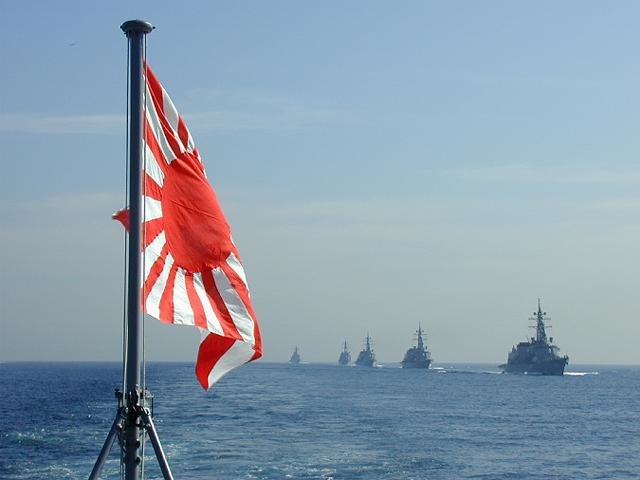
South Korea violates international law of the sea by not allowing the Japan Maritime Self-Defense Force the right of innocent passage - The Rising Sun flag is a reminder of the past.
2022-10-29
Category:South Korea I'm participating in the ranking.Please click and cheer for me.
The right of innocent passage is a right granted to United Nations member states
International law of the sea provides ships with the right of innocent passage. Even if ships are within the territorial waters of a coastal state, they may pass without obtaining prior permission from the coastal state, provided that the navigation is not considered harmful as stipulated in Article 19-2 of the United Nations Convention on the Law of the Sea. Thing. In this case, you will need to display the flag of your affiliation. It is a national flag or military ensign.
South Korea rejects the Maritime Self-Defense Force because of the Rising Sun flag
When considering the Rising Sun flag issue in terms of the meaning of this treaty, South Korea does not recognize the right of innocent passage to the Japanese Maritime Self-Defense Force, even though it has ratified the International Convention on the Law of the Sea. In other words, it is a violation of international law. On the other hand, Japan recognizes the right of innocent passage for Korean ships. The reason is that Japan has ratified the International Convention on the Law of the Sea.
Violation of China's territorial waters does not fall under innocent passage
In response to a question in the Diet about the relationship between Chinese ships repeatedly invading territorial waters around the Senkaku Islands and the right of innocent passage, the government decided in June 2021 that this does not constitute innocent passage as recognized under international law. expresses an opinion. The reason for this is that China claims sovereignty over the Senkaku Islands, which are part of Japan's territory, and that violating its territorial waters does not constitute innocent passage, but on the contrary, it is a violation of international law.
Because it reminds me of the past...?
Has the South Korean government ever issued an official opinion regarding the Rising Sun flag and the right of innocent passage for Japanese ships, including those of the Japan Maritime Self-Defense Force? It should be released. Saying that you don't like it because it reminds you of the past is no basis for denying the right of innocent passage. This is because there is no such thing in Article 19-2 of the United Nations Convention on the Law of the Sea, which states that navigation is considered harmful.
I'm participating in the ranking.Please click and cheer for me.
The people's trial that began in the wake of the Itaewon accident - The horror of a country where all citizens think they are jurors
Is President Yoon responsible for the Itaewon accident?
A surprising public opinion poll
The police have administrative jurisdiction and are under the jurisdiction of the prefectural police
Is the president in charge of Halloween?
It appears that a candlelight demonstration was held in Itaewon, Seoul on Halloween in the name of commemorating the victims. South Korea is apparently the country of demonstrations, but organizers said ``50,000 people gathered.'' Police estimate the number of participants to be 9,000. The purpose seems to be to hold the current President Yoon's administration responsible for the Itaewon accident and demand his resignation.
A public opinion poll was conducted, and found that the government was responsible for the Itaewon disaster.73.1% said it was responsible, 23.3% said it was not responsible, and 53% said it was extremely responsible. Considering whether the decision should be based on public opinion polls in the first place, I wonder if South Korea's famous all-citizen jury trial system has started again. In the first place, it must be said that he is in a state of cessation of thinking, meaning that he does not have the composure to analyze the responsibility and causes of the problem.
Japan's police force is handled by the National Police Agency, which has administrative jurisdiction. The National Police Agency will be positioned as a special organization within the Public Safety Commission, which is an external bureau of the Cabinet. Rather than directing and supervising the National Police Agency on individual cases, the Public Safety Commission sets general policies and supervises whether they are being operated appropriately.
As it is an administrative organ, the main body of work lies with local governments, and prefectural police are responsible for accidents and incidents that occur under their jurisdiction. Hyogo Prefectural Police was held responsible for the Akashi fireworks display accident, and Nara Prefectural Police was held responsible for Abe's assassination.
They seem to be claiming that the president is responsible for the Itaewon accident, but that is not the case at all under Japanese law. What about Korean law? Normally, responsibility should be assumed by the person in charge, but does this mean that President Yoon should grasp the details of the security system and issue instructions regarding Halloween security? Or should we have decided by presidential order that this is how we should enjoy the Halloween festival?
Meeting with South Korean parliamentarians and Foreign Minister Hayashi. Is it meaningful to deal with mere performance diplomacy? An unprecedented response between members of the Diet and government ministers
Foreign Minister Hayashi met at the Ministry of Foreign Affairs on the morning of the 25th with the "policy consultation delegation" sent by South Korean President-elect Yoon Seok-you to Japan. There have been criticisms within the Liberal Democratic Party of having a meeting between a mere parliamentary group that has not yet been established as a government and Japanese government ministers. Since it is unknown whether they are really delegations, will the Foreign Minister visit all of them when a foreign member visits Japan? And since I had an interview with the members of the Diet, there is no reason why Yoon Seok-you would not have an interview after taking office as president.
Interview in a state of violation of international law
Currently, the Japanese government is in a position not to negotiate unless the Korean government corrects the state of violation of international law, and the state of violation of international law has not changed yet. After that, They had a meeting with former Minister of Finance Fukushiro Nukaga of the Liberal Democratic Party and former Minister of Education, Culture, Sports, Science and Technology Nakagawa of the Constitutional Democratic Party, who are the chairman of the Japan-Korea Parliamentary Union, at a hotel in Tokyo for about an hour and a half. One of the points that should be evaluated is that the Korean parliamentarians should return to the Japan-Korea relations at the time of the 1998 Japan-Korea Joint Declaration. In 1998, it became a joint declaration that embodied the ideal way of exchange between Japan and South Korea from the 1965 Japan-Korea Basic Treaty, such as the opening of Japanese culture in South Korea and the resolution of the problem of fishing rights in Takeshima. Even if it is simply said to improve Japan-South Korea relations, it is commendable that they have discussed them many times and have shown specific target points because the Korean side has destroyed everything for their own convenience. However, even if it returned to the time of the Japan-Korea Joint Declaration, this declaration was virtually invalidated by the National Assembly of South Korea in less than two years. How can we prevent it from being invalidated again even if it returns in 1998? That point is missing.
Do you make another promise with a country that does not keep your promise?
I think that the problem that South Korea does not keep its promise is that the country itself does not have a structure to keep its promise. Even if the president of that era considers the times and makes a promise with Japan through diplomatic immunity, Korean parliamentarians who have an anti-Japanese structure and an anti-Japanese constitution will invalidate them with the power of the legislature. Is the Kishida administration rushing for easy diplomatic achievements as it has no diplomatic achievements so far? Foreign Minister Hayashi is in a good mood playing the piano in the United Kingdom. Will he repeat the Japan-Korea relations that he has repeated over and over again?
With only three days left before the South Korean presidential election, what is the contrast between the two manifestos and Japan - South Korea relations?
The Korean presidential election is only three days away.According to the latest opinion polls, the two seem to be at odds with each other's throats.In the past presidential election, it seems that the dominant candidate in the last poll won the election.Generally speaking, voter turnout is not the only way to go up.If the turnout is low, it will benefit the conservatives as well as the current administration.If voter turnout rises, those who are not usually interested in politics will participate in politics, which will be motivated to change the status quo.
Moon Jae In was working hard on how to get floating votes.This is the minimum wage increase and the feminist movement.And, it succeeded in winning floating votes for young people and women.The result is the worst policy, but the 2022 manifesto shows that there are many contrasting and worrying parts.Lee Jae-myung said, "It includes correcting Moon Jae In's mistakes.Specific industrial investments will create jobs, and urban functions would be dispersed as a countermeasure soaring land prices in Seoul.Yoon Seok-yeol, on the other hand, advocates attracting and increasing investment through the free economy.This is in contrast to industrial investment by large governments and job creation by small governments.
Lee Jae-myeong is pro-China and Yoon Seok-yeol is pro-U.S. in terms of diplomacy and defense.Yoon Seok-yeol mentioned the deployment of additional Saad.This means that the agreement with China will be scrapped.This means that China will confront China, but China is likely to impose economic sanctions on the Korean economy, which is highly dependent on China.Lee Jae-myeong did not mention the relationship with Japan, and Yoon demanded an apology and compensation from Japan.Does this mean that Japan-South Korea relations will be included in the U.S.-Japan relationship, rather than immediately restoring Japan-South Korea relations?In any case, if the right wins, there will be room for future negotiations from the Japanese side.However, relations between Japan and South Korea will end again when they demand an apology and compensation for the Japanese Military comfort woman issue.
No matter which candidate wins, I don't think I can expect much about Japan-South Korea relations.
South Korea has always opposed registration as a World Heritage Site. The meaning of culture is different from the rest of the world. People from all over the world come to Japan for a variety of reasons, including culture, history, anime and manga, cat cafes, maid cafes, traditional Japanese food, and other gourmet food. These are evaluated within the framework of culture. If we look at the definition of culture, we find that `culture is a system of ideas and value standards shared within a society, and a unique style possessed by a group.'
Cultural heritage must be something that has survived for a certain period of time, and can be thought of as something that has had a major impact on subsequent eras, and can be considered to be the "culture" of each country. It can be said that it exists within the range of value standards and definitions. Furthermore, Japan has registered 20 World Cultural Heritage Sites.
In this sense, South Korea is the only country to raise questions about Japan's registration as a World Cultural Heritage Site. This is not a historical issue, but simply a difference in the definition and framework of culture. Can they explain why Auschwitz in Germany and the Colosseum in Italy are world heritage sites? The Colosseum is an arena for killing each other.
If the common concept of ``culture'' in each country is the premise of world cultural heritage, then no Japanese person would object to the fact that Auschwitz and the Colosseum are cultural heritage sites. This is the Japanese way of thinking. In other words, it is different from Korea.
People visiting Japan come to see that there is almost no garbage left on the roads all over the country, and to see that the natural environment is still kept clean in one of the world's most developed countries, which is unique in the world. Although it can be said that this is Japanese culture that cannot be seen, there is no framework or precedent for considering such a culture that spreads throughout the nation as a cultural heritage.
Even if such a cultural framework were to match the world's definition, only South Korea would be opposed to it.
Representative Yuko Obuchi appeared at the Japan - Korea summit meeting *A wedge telling South Korea not to forget what she said. A meeting and dinner was held between Prime Minister Kishida and President Yun Seok-Yeol, and a press conference was held without a joint statement.
What has been decided is the resumption of shuttle diplomacy and the lifting of restrictions on three strategic items. In reality, the matter falls under the jurisdiction of the Ministry of Foreign Affairs and the Ministry of Economy, Trade and Industry, but the actual content is that the leaders met together to confirm the matter.
Regarding the lifting of restrictions on strategic substances, in reality there will be no major changes in distribution from Japan, and the 2019 restrictions will not reduce or stop exports, so nothing will actually change.
In particular, President Yun Seok-Yeol raised the issue of North Korea and showed South Korea's cooperative attitude toward Japan, but this has only confirmed that this is back on track. This is natural since the North Korea issue is being dealt with through the Japan-U.S. Security Treaty and the U.S.-South Korea Security Treaty.
At the very least, future shuttle diplomacy should ask what South Korea can do for Japan, rather than the diplomatic relations that have been the case in the past, where Japan did something unilaterally.
That's what makes for healthy diplomatic relations. I can't think of anything specific that South Korea has done for Japan. No one is looking for diplomatic relations that involve chatting at the table and asking for wads of money under the table.
The next day, the Japanese media focused on the meeting between Suga, president-elect of the Japan-Korea Parliamentary Federation, and President Yun Seok-yeoul, but what I wanted to draw attention to was the woman in the very edge of the photo.
She is Yuko Obuchi, a lawmaker, and the daughter of former Prime Minister Keizo Obuchi. The reason I wondered why she was in this seat was because I remember her not holding any government-related positions.
What really struck me was the 1998 Japan-Korea Joint Declaration. President Yun Seok-Yeol insists that Japan-Korea relations should return to the Japan-Korea Joint Declaration, but the question is how to return. And Japan complies with all of the Japan-Korea Joint Declaration. Returning would be a problem only for the Korean side.
The points of the 1998 Japan-Korea Joint Declaration are as follows.
Japan-Korea Joint DeclarationHolding of the 2002 FIFA World Cup
Promoting Japan-Korea economic cooperation
Opening of Japanese culture in Korea
Fisheries agreement around Takeshima in accordance with the new United Nations Convention on the Law of the Sea
Response to North Korea issue
The holding of the Japan-Korea World Cup and the influx of Korean Wave content all stemmed from this joint declaration.
The Japan-Korea Joint Declaration was signed by President Kim Dae-jung, but the Japan-Korea World Cup was said to be the worst tournament in FIFA history, and it became unclear whether it was an anti-Japan movement or a soccer tournament.
Less than two years later, the South Korean National Assembly passed a resolution to invalidate this joint declaration. Japanese people must not forget that the area around Takeshima was subsequently filled with Korean fishing boats again, resulting in the current state of Takeshima.
The Japanese representative who concluded this agreement was former Prime Minister Keizo Obuchi. South Korea has completely torn up not only the 1965 Agreement, but also the 1988 Agreement.
Was Representative Yuko Obuchi invited to this meeting as a symbolic icon? In other words, this seems to have driven a wedge that returning to the Japan-South Korea Joint Declaration is the goal of the talks. It's about not forgetting what I said. Does the Korean side actually understand the meaning of this? I don't think they understand.
In conclusion, returning to the Japan-Korea Joint Declaration would be a very high hurdle. This joint declaration was scrapped because of the Takeshima issue. Perhaps the Korean side only understands this declaration as a resumption of cultural exchange.