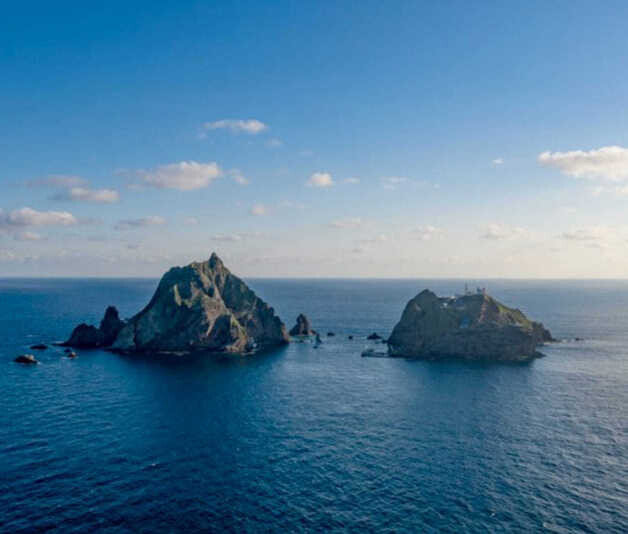
Anti - Japanese professor Seo Kyung - duk asks Apple to refer to Dokdo throughout the world? I don't like him even though he was considerate to Korea.
2022-08-21
Category:South Korea I'm participating in the ranking.Please click and cheer for me.
[Donga Ilbo translated article]
Seo Kyung-deok, famous for being anti-Japanese
Seo Kyung-duk, a professor at Seong-Shin Women's University, has decided to change the name of Dokdo for each country in relation to the fact that Korea's ``Dokdo'' appears differently depending on the language settings in Apple's iPhone map application. The company announced on the 20th that it will consider whether to protest in the future.
Takeshima is commonly known as Liancourt Reef
On the morning of the same day, Professor Seo posted on his social networking service (SNS), ``How will Dokdo and the East Sea be represented in each country on Google Maps, the map app most used by people around the world in 2019?'' ``As a result, netizens living in 26 countries reported that all of Dokdo can be searched for ``Liancourt Rocks'' on Google Maps.''
I don't like it even though I took South Korea's claims into account
It goes on to say, ``Dokdo is only accurately described in South Korea, and Google Map searches in Japan show ``no results'' or ``Takeshima'' (Takeshima, the name of Dokdo claimed by Japan). ``We have been steadily protesting to Google, but changing the name to ``Dokdo'' was not easy.''
``Recently, when the language is set to Korean in the Apple iPhone map app, ``Dokdo'' is correctly displayed, but when it is set to Japanese, it is written as Takeshima. "After doing so, please provide information on how Dokdo and the East Sea should be represented on the map installed on the iPhone."
Read it together
South Korea failed to participate in the San Francisco Peace Treaty and Peace Conference.a Rusk letter sent to them. Article II of the San Francisco Peace Treaty
(a) Japan acknowledges the independence of Korea and renounces all rights, rights and claims to North Korea, including Jeju Island, Geomun Island and Ulleung Island;
On July 19, 1951, Korean Ambassador to the U.S. visited Darres and handed over a letter to Secretary of State Dean G. Acheson at the instruction of the Korean government. The request for amendment to Article 2(a) shall be amended to "confirm that all rights, rights, and claims were waived on August 9, 1945, before the Japanese annexation of Korea, including Jeju Island, Geomun Island, Ulleungdo, Dokdo, and Parang Island."
"Unfortunately, the U.S. government cannot agree to amendments to the proposal," Rusk said in a letter.The U.S. government does not think the treaty should adopt a theory that Japan's acceptance of the Potsdam Declaration on August 9, 1945 constitutes Japan's formal or final renunciation of sovereignty over the region covered by the declaration.As for the island known as Dokdo or Takeshima or Liancourt Rock, this normally uninhabited Iwashima has never been treated as part of Korea according to our information, and has been under the jurisdiction of the Oki branch of Shimane Prefecture since 1905.I don't think this island was once claimed by Korea."
In response to South Korea's persistent request, the U.S. denied South Korea's Takeshima sovereignty as a final answer.
Article 2(a) of the San Francisco Peace Treaty was officially issued.As you know, 52 countries participated in the San Francisco Peace Conference and agreed on what Japan would or would not give up its sovereignty, and Japan returned to the international community based on the resolution of the postwar compensation issue.By the way, 49 out of 52 countries signed .The three countries that failed to sign the agreement were the Soviet Union, Czechoslovakia, and Poland, which were invalid because China did not participate.
What does the South Korean government mean by international law that claims Takeshima to be Korean territory?
It is clear that Takeshima is Japan in terms of international law and history.Korea's claim is completely unfounded.
Is everyone in the world insisting that Takeshima become Dokdo?
Meanwhile, the issue of Apple's guidance on the notation of Dokdo came to the fore on the 18th, when the private cyber diplomatic mission 'Bank' (VANK) officially raised the issue. At the time, Bank said, ``It is a clear mistake for Apple to refer to South Korea's Dokdo differently depending on the language in which it is designated, and Coms.'' ``We will send a protest letter requesting that this be corrected, and we will also carry out a rectification campaign.'' "I guess so," he argued.
No concessions to that country
I think that the Japanese people are starting to realize this recently, but making concessions to that country is a no-no. If they think so, then it's a matter of luck if they think it's okay to make concessions to this extent. They just think that because the other side has given in, they can go further and further.
I'm participating in the ranking.Please click and cheer for me.
According to a Korean public opinion poll, the support rates for political parties are 42.4% for both opposition parties, and 39.6% for People's Power.The general election will be held this year.
According to a Korean Realmeter opinion poll conducted in the fourth and fifth weeks of March 2020, the party support rate was 44.6% for the Democratic Party of Korea, and 30.0% for the United Future Party, the predecessor of People's Power. The Realmeter survey results announced on the 15th of this month show that the Democratic Party is 42.4%, and the People's Power is 39.6%.Although the gap has narrowed, the Democratic Party's approval rating has fallen by only 2.2 points. do not have.
In the 2020 survey, 55.7% approved of Moon Jae-in, and in the current survey, 36.3% approved of President Yoon Seok-Yeol. Interpreting these figures literally, expectations for the power of the people in the legislature have increased, but the support rate for the Democratic Party has remained almost unchanged. Both parties are members of the Democratic Party, whose party is led by Lee Jae-myung, who miraculously survived the assassination that everyone thought was a farce and was discharged from the hospital after a long hospitalization. Lee Jae-myung is currently being indicted by prosecutors.
These Democratic Party supporters can be seen as a rock-solid support group that will continue to support any party leader no matter what. Are these people who make a living through trade with China, and whose livelihoods are directly connected to their support for China? South Korea's trade dependence is 81.9% of GDP. The pro-Japanese and pro-American and pro-China and pro-North Korean compositions were one of the themes brought to light by Moon Jae-in, who stirred up the No Japan movement, but the essential issue is the economy. How far has the withdrawal from China's economy progressed?
In the Facebook group of the author who co-authored ``Anti-Japanese Tribalism,'' it is clear that the number of posters and viewers has decreased dramatically since Yun Seok-yeo became president. Is it because the No Japan movement has subsided? In that case, would those people have been better off if the No Japan movement had disappeared? I wonder how many people out there just wish they could drink Japanese beer. In other words, were the pro-Japanese simply rebelling against the intense anti-Japanese movements that were taking place? At least what we can say is that the power of pro-China, pro-North Korean forces does not seem to be weakening.
If we go into the 2024 general election in this state, there is a high possibility that the Democratic Party will once again control the largest number of seats. If this is the case, the Yun Seok-Yue administration will be run in a twisted manner throughout his term. Anti-Japanese issues are also legal issues. South Korea is a country with no anti-Japanese convictions. Since the Democratic Party is the most powerful party in both countries, it is difficult to bring about social change through legislation, and there is a high possibility that an anti-Japanese leftist president will be elected again in the next presidential election.
South Korean delegation insists on 'efforts from both countries' - Japan is fulfilling all its promises - South Korea is the one who is not making enough efforts
South Korea says efforts from both Japan and South Korea are necessary
Intentions of both countries passing each other
What is the destination that Korea envisions?
If we misunderstand the Korean issue, the government will tilt
Japan has already apologized many times
Japan fulfills all commitments
What does the effort of both countries mean?
While the recent South Korean delegation's visit to Japan has been reported as if the two countries have once again returned to the direction of improving Japan-Korea relations, the response of the Japanese government, including the prime minister, has been criticized. The South Korean side is keen to improve Japan-Korea relations, and as a result, interviews with the current prime minister, former prime minister, and other ministers were held. The most important point is that a gap that cannot be filled has been identified.
The rift is that while Japan is demanding that South Korea "fulfill its commitments," South Korea has consistently stated that "efforts from both sides are needed." This means that South Korea will not make unilateral concessions. More specifically, before the presidential election, President-elect Yoon Seok-Yeol met with Lee Yong-soo, a self-proclaimed representative of former comfort women, and said, ``We must demand an apology from Japan.'' has promised that he will receive it. That's probably what he's saying.
What kind of efforts does South Korea want from Japan? For example, is the Japanese Prime Minister going to South Korea, meeting with former comfort women, apologizing, and reporting the moving scene as an attempt to settle the matter? However, if South Korea's next government does not understand that this is an unlikely future, improving relations seems a long way off.
If Prime Minister Kishida were to do something like that, the Kishida administration would surely collapse, and even in this meeting with the parliamentary group, there are voices calling for Kishida to be removed from the position of prime minister. There are even voices saying that they will not vote for the Liberal Democratic Party in the next House of Councilors election. Reasons for this include the forced labor judgment and the abrogation of the Japan-Korea comfort women agreement.
Regarding the South Korean delegation's visit to Japan, since it was a group of parliamentarians before the inauguration of the new South Korean government, there were many opinions that Japan should also conduct the visit within the framework of parliamentary exchanges and that the government should not deal with it.
The comfort women agreement states, ``This is an issue that has deeply damaged the honor and dignity of many women, and from this perspective, the Japanese government is acutely aware of its responsibility.'' I would like to express my heartfelt apologies and remorse to the people of... Yun Seok-Yeol seems to think that since he has expressed his apology, it would be okay to apologize face-to-face. However, the agreement states, ``As the Japanese government declares the above and steadily implements the measures in (2) above (establishment of a foundation), this announcement will ensure that this issue will be finalized and irreversible.'' to make sure it is resolved."
The 1965 Claims Agreement, including the issue of forced labor, was already resolved. Japan is simply asking South Korea to faithfully implement these agreements. Japan has fulfilled all of its responsibilities, so all that remains is for South Korea to fulfill its own responsibilities. In other words, it is no longer an issue for both countries to make efforts.
Jeong Jin-seok, head of the South Korean delegation, claps his hands together and says that only by joining hands like this can relations be improved. Hearing these words, I can't help but think that South Korea's next new government may not even understand what the current situation is. This is because the efforts of these two countries resulted in the Claims Agreement in 1965, the Japan-South Korea Joint Declaration in 1998, and the Comfort Women Agreement in 2015, which is exactly the kind of hand-to-hand situation that Chung described. It is South Korea that unilaterally abolished these . Japan must not take a step back from this line.
If we look at Japan-South Korea relations after the restoration of diplomatic relations, South Korea has completely torn up all previous agreements. Is the next agreement really necessary?
His Majesty the Emperor visited Saipan
In 2005, the Emperor and Empress visited Saipan to pay their respects to the war dead.In response, a protest demonstration was held by a Korean group.It seems to be the idea that the Emperor's memorial service for the war dead is the revival of militarism.
Angered by the movement, Saipan residents shouted, "If Koreans protest against the Emperor, let's boycott Korean companies," and John Blanco urged native Chamoros and Carolina residents to boycott Korean companies if Koreans hold scheduled protests next Tuesday.Nevertheless, the Saipan Korean Association spread out banners and staged a demonstration demanding an apology from the Emperor.
The Japanese probably don't understand the idea that visiting the memorial is the revival of militarism.It was the same for Saipans.
An old Chamorro woman rose to her feet."How rude of the Emperor to come to the memorial service!I won't forgive you!" he exasperated, "You guys get out of Saipan."Don't do anything selfish on our island," he told local residents and the media one after another.As a result, many Chamoros supported the demonstration, and it developed into a huge demonstration to welcome the Emperor.
It was the 60th anniversary of the end of World War II, when the Emperor and Empress visited Saipan with a warm welcome on June 27th and 28th.
Korea justifies anti-Japanese demonstrations regardless of where they are.Saipan residents got angry at this and developed into a welcome demonstration for the Emperor.
Yun Seok - yue's manifesto aims to attract and circulate capital through a free economy.Will the National Assembly become a burden that hinders this?
South Korea is wavering between pro-China and pro-US
Original regime change through social policy
A country that thinks about what is better
Yin Seok-yue promotes free economy
Promoting free competition within the country and moving towards CPTPP
Legal development by the Diet is hopeless
Is South Korea wondering whether it should join China, which has achieved growth in recent years, or join the camp of free nations such as Japan, the United States, and Europe? I guess it's a question of which is better, but it seems like a very polarizing choice.
The Moon Jae-in administration completely abandoned its pride as a democratic country without hesitation and spent five years desperately trying to join China and North Korea, a country that violates human rights at its worst, but unfortunately there was no result. Ta.
The new president, Yun Seok-Yeol, has the exact opposite policy, aiming for Korea to be a member of the Japan-U.S. and liberal camp. This seems to be the composition of the right-wing and left-wing forces in South Korea.
The left tends to seek the enhancement of social institutions, while the right tends to seek free competition and liberal democracy. This is a question of the balance between social welfare and liberal economics, and a debate about competition versus distribution. This is an issue to be debated within a democratic country, and can be said to be a universal frame.
America's two-party system is very easy to understand. Republicans and Democrats can be broadly divided on the question of whether taxes should be primarily used for public welfare, or whether they should reduce taxes in the first place and increase competitiveness in a free economy. It is also expressed in the framework of big government and small government.
The choice of domestic social policy is not a question of which country will benefit you by following, but rather a matter of foreign policy. Prior to Japan's annexation of South Korea, there was intense conflict between pro-Russian and pro-Japanese factions on the Korean peninsula. Is nothing different from that era? Another characteristic of South Korea is that its foreign policy is also its domestic policy.
Looking at Yun Seok-Yue's manifesto from the perspective of economic policy, his economic policy is to bring back the capital that fled South Korea under the Moon Jae-in administration.
In particular, the focus is not on where to focus investment and foster industry, but rather the policy appears to be aimed at attracting investors by abolishing regulations and promoting a free economy and free competition.
It appears that the plan is to aim to join the CPTPP and other liberal nation frameworks based on this liberal economic frame, but in order to realize this, it will be necessary to obstruct the various free competitions that exist within Korea. Legislation must be put in place to abolish the regulations that apply.
This is the job of the National Diet, the legislative branch, but the opposition Democratic Party of Japan still holds nearly 60% of the seats. In other words, there are many hurdles for the time being in the economic policy advocated by Yun Seok-Yeol and cooperation with liberal countries. In other words, we will have to wait for the 2024 general election.
Korea, where the government recognizes history, will not be revised even if new facts are discovered.
History is just a collection of cognition.History of the past is incorporated into history in accordance with the interpretation that it is the same with one sentence, one letter, and one word.It is impossible to prepare enough evidence in history to confirm the facts in the current trial.
History recognized as the past is corrected by newly discovered facts.It is a case in which conflicting statements are found in past views that have been found.Whenever new facts are discovered in historians' quest, historical cognition is corrected.
In Japan, new facts have been discovered and history has been reviewed one after another.U.S. military information such as Hullnotes, which triggered the start of the Pacific War, has been released one after another after the deadline for confidentiality.As a result, the U.S. military's Sea of Japan chart, which is the basis for the start of the war and the dropping of atomic bombs, and the establishment of borders in Sea of Japan after the war, has been discovered and revised.
How do you explain that the photo in the textbook, which was published as a forced work man in Korea, was found to be a Japanese working in a coal mine and canceled it?
King Gojong, for example, is said to have failed to sign the Japan-South Korea annexation treaty.What would happen if King Gojong found a new note saying he was in favor of the annexation treaty?Will Korea correct history?
If the Japanese government is to be found guilty of the Japanese Military Sexual Slavery issue, it must at least present substantiable evidence under current law.It is evidence to support when, who, how, and in what way.There is no such evidence and is sentenced only by testimony.
History is like a creature that is constantly examined, supplemented, and corrected within the bounds of academic freedom.Therefore, it is impossible for the government or the judiciary to determine history.
The "no distortion of history " and "pro-Japanese praise ban " proposed in South Korea are laws that do not change the history of Koreans being enslaved under Japanese rule and prohibit the development of the Korean Peninsula under Japanese rule.
In other words, the legislature is submitting legislation that restricts freedom of speech and suppresses academic freedom.
Historical problems are basically problems between historians.The government of that time cannot recognize history.