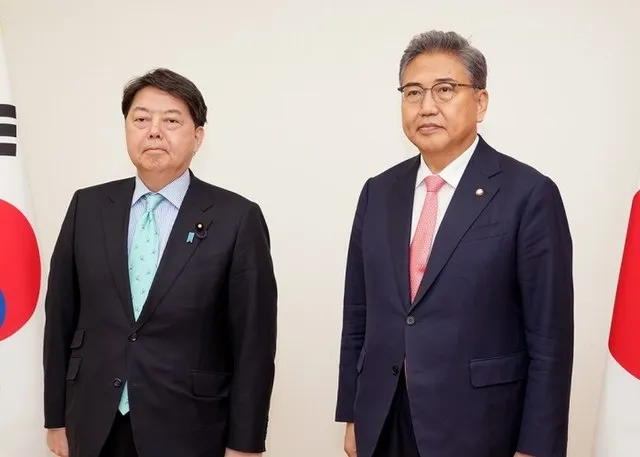
South Korean Foreign Minister Park Jin strives to resolve the forced labor and comfort women issue - What does the Korean economy, where the won continues to be weak, demand from Japan?
2022-07-20
Category:South Korea
I'm participating in the ranking.Please click and cheer for me.
The South Korean Ministry of Foreign Affairs is extremely knowledgeable
South Korean Foreign Minister Park, who is visiting Japan, emphasized that regarding the issue of labor recruitment lawsuits, ``We are making efforts within South Korea to find a desirable solution before cashing out,'' and added, ``The Japanese side also responded with a sincere response.'' I would appreciate it if you could give me that."
Mr. Nukaga, who met with him after the meeting, told reporters that he "intended to respect" the 2015 comfort women agreement that confirmed the "final and irreversible resolution" of the comfort women issue. I made it.
South Korea is keen on restoring Japan-Korea relations
The current Yun Seok-Yue administration appears to be eager to repair relations with Japan. Before he took office as president, he sent a delegation of members of Congress to express his sincerity, and after taking office, the Minister of Foreign Affairs has shown an attitude of fully accepting the intentions of the Japanese side. But don't let your guard down.
Korea's diplomatic techniques that you can't let your guard down
The South Korean government's approach so far has been to extract some kind of concession from Japan, take it as a diplomatic credit, and then try to make a temporary move, and the pattern is to come back to it again and again.
Japan should negotiate without losing its stance that there is nothing Japan can do. In reality, the issue of post-war compensation has already been resolved in all agreements between Japan and South Korea.
The true feelings of getting closer to Japan
The Korean won continues to be at a low price with no signs of rising. Due to the impact of interest rate hikes and the Bank of Korea trying to recover the won spent during the coronavirus pandemic, corporate investment will slow down. Since the won is not depreciating as sharply as before, it seems that the price is not falling off a cliff and is managing to cope even with the price dropping to around 1,300 won.
Excited about swapping
The US Federal Reserve has also begun withdrawing dollars from the market and raising interest rates. The Korean government wants to carry out another swap and looks at the American expression, but its expression remains firm. That's why it's Japan. I would like to somehow conclude a swap with the key currency to provide peace of mind.
Although South Korea has experienced economic growth, its industrial structure is a chaebol economy that generates profits through processing trade through bulk purchases and bulk sales, so domestic demand never grows, and it is greatly affected by exchange rate fluctuations. The national debt is increasing, household debt has exceeded GDP, and land prices in Seoul continue to soar, making it difficult to see when they will rebound. There is nothing wrong with the fact that Won is vulnerable.
To what extent will the Japan-Korea issue be resolved
The Japan-Korea issue is not just about the forced labor issue or the comfort women issue. In addition to the Takeshima issue, South Korea has broken all of the agreements that Japan and South Korea have concluded to date. The Japan-Korea joint declaration was left blank. The issue of excluding countries from the White List stems from concerns about the transfer of funds to North Korea and third countries.
Clarify what relationship improvement means
Just because the issue of forced labor, which is about to be turned into cash, and the issue of comfort women, where statues of comfort women are being erected all over the world, are recent issues, it is normalization because these two issues have been resolved. Would you? In the first place, when South Korea refers to normalization, it means that they want to go back to the days when they were given special treatment.
Special treatment is over
Why did South Korea become a white country? Why did Japan do swaps during two economic collapses? This is only because Korea was given special treatment. It should be made clear that there will never again be a time when relations are treated as special even though they have been normalized.
I'm participating in the ranking.Please click and cheer for me.
[related article]
Moon Jae - in's words regarding Park Geun - hye's pardon are abstract; who is the one who created the division?
[Excerpt from Chosun Ilbo article (translation)]
On the 24th, former President Park Geun-hye expressed her gratitude to President Moon Jae-in for granting him a special pardon.
Lawyer Yoo Yong-ha, a close aide to former President Park, met with reporters in front of Samsung Seoul Hospital in Gangnam-gu, Seoul, where former President Park was hospitalized, and relayed former President Park's words on his behalf.
Regarding former President Park's health condition, attorney Yoo said, ``It looks like she will be receiving treatment at a hospital for the time being,'' but added, ``I cannot comment on the specific health condition right now.''
Regarding former President Park's future plans, lawyer Yoo said, ``Right now, he is concentrating on treating a new disease.He told me that he would not meet with anyone.''
On this day, to celebrate the new year of 2022, the government granted a special pardon to former President Park, who is currently in prison after being found guilty in the National Agricultural Organization Incident.
``We must overcome the pain of last year and move on to a new era,'' President Moon said, ``I hope that this will be the beginning of a new era of unity and harmony that transcends differences and pros and cons.'' .
President Moon said, ``Rather than being buried in the past and fighting each other, it is time for us to boldly work together toward the future.''Especially given the many challenges facing us, we must strive for national unity and humility.'' There is an urgent need for inclusiveness."
[Excerpt above]
Moon Jae-in's words have an abstract meaning: the people will come together as one and create a new era.
It is said that Moon Jae-in himself was the one who created the cause of the nation's division in the first place. The main argument of the opposition parties is that Moon Jae-in became president after taking advantage of Park Geun-hye's impeachment, and that the current left-wing government is the one that carried out various schemes surrounding the impeachment.
There are many people who feel that it is strange that this pardon was decided for the exact same reason as the previous pardon was not granted.
In South Korea, the president is arrested every time there is a change of government. Perhaps because of the culture of grudges, there is a history of retaliation for retaliation.
Many people take this to mean that Moon Jae-in is asking for a pardon and the charges against him to be reduced.
Moon Jae-in's term remains until next year's presidential election. Many people seem to feel uncomfortable about being pardoned at this timing.
The exchange won rate has not stopped falling.The No Japan movement is a campaign to buy domestic products.Nothing will change under the chaebol economy.
South Korea's trade dependence on GDP is more than 70 percent, including the service sector.In other words, domestic demand is low and foreign exchange is directly affected.Even if foreign demand is received, it does not circulate at home and flows abroad.If the person who made the purchase contract increases the dollar by 5% at the time of payment, the payment will increase by 5%.The won-dollar exchange rate is 1,200 won, but it has been hovering around 1,200 won in recent days.
In order to maintain international competitiveness, chaebol companies such as SAMSUNG buy parts in bulk and produce them in bulk to reduce costs and sell them at low prices.In this case, large debts are always carried out and large payments are repeated, and problems arise when the value of the currency changes significantly during that period.This is the so-called default.Under these circumstances, the won's international credit rating has not increased, and South Korean companies can trade in dollars depending on the L/C of Japanese commercial banks.
South Korea experienced two foreign exchange crises in 1997 and 2008.No country will experience two foreign exchange crises in 10 years.In other words, South Korea's industrial form is vulnerable, and in short, it is trading beyond its currency capabilities.
Considering what Moon Jae In wants to do, the real intention is to socialize, control the currency, and stabilize the value of the won.Do you think the boycott is a campaign to buy domestic goods if it is reversed?
South Korea is listed by the FRB as a currency manipulator.
The reason why domestic demand is not expanding is the existence of chaebol companies.The role of chaebol companies in driving the Korean economy is important, but on the other hand, investment in chaebol companies is concentrated and other industries are not growing.In addition to the businesses run by chaebol companies, how can Korean companies grow globally?It can only be done with its own money without investment.
This structure will not change even if there is a boycott Japan.As a currency manipulator, even if it leaves the liberal economy, it will not change.It is necessary for the government to take the lead in fostering domestic demand and to attract investment in what industries to foster domestic small and medium-sized enterprises.The boycott Japan does not mean that South Korean domestic companies' sales will increase.
Moon Jae In's term of office is less than three months, and criticism from his country seems to be gathering.I think it's quite late from Japan view.
Anti - Korean sentiment in the world
When comparing data from the BBC on positive and negative impressions of Japan and South Korea, a surprising number of countries have a negative impression of South Korea (Reference wiki)
Japan has been at war with China in the past, so we can predict China's feelings towards Japan, but what exactly is South Korea like? Regarding China's sentiments toward South Korea, relations between China and South Korea deteriorated in 2016 when South Korea decided to deploy THAAD, but even if you look at domestic surveys conducted before then, it appears that China's reputation towards South Korea was quite unfavorable.
2007 "Xinhua News Agency" survey results: South Korea ranks first in "neighbors I don't like"
2007 “Tengai Community” survey results. ``Most hated country'' South Korea ranks first
2009 “Global Network” survey results. 94.6% of respondents said they did not have a favorable impression of South Korea.
It has long been pointed out that anti-Japanese campaigns around the world are a strategy to tarnish Japan's image, given that Japan and South Korea have similar industrial structures in the face of global competition.
But when you look at the data... In the first place, isn't the idea that one benefits by degrading others itself wrong?
Yoon Seok - yeol's digital strategy in Korea.World - class? Does he know what 6G and AI mean? This is an excerpt from an article made by Yun Seok-Yeol of the opposition People's Power, who is running in the Korean presidential election. It seems that Japan is aiming to become a digital hegemony. And South Korea will lead the way in 6G...
Presidential candidate Yoon Seok-yeol announced on the 28th that Korea will become a digital economic hegemon by training ``1 million digital talents.'' Candidate Yoon pledged to create a flexible work environment that suits the characteristics of the IT industry, and raised the need for flexible work, saying, ``Is it possible to restrict people from working from home for more than eight hours?'' I emphasized it again.
Candidate Yoon's comments are expected to be controversial as the Labor Standards Act already restricts working hours to over eight hours. Candidate Yoon held a press conference in Yeouido, saying, ``In order to reduce the technological gap with developed countries, we will raise next-generation artificial intelligence technology to the highest level in the world.'' We will introduce solutions and build the best AI system."
It seems that within three years we will reduce the technological gap with developed countries and raise it to the highest level in the world. I don't understand the meaning at all.
Candidate Yoon's vision is for South Korea to build the world's fastest and most powerful digital platform, export it to countries around the world, and become a digital economic hegemon. Developing an artificial intelligence industry was mentioned as one of the six practical tasks for this purpose. In detail, he explained that the company will build the world's largest cloud computing infrastructure for AI that can be used jointly by universities, research institutes, and companies. For the development of the software industry, he promised, ``The digital platform government will welcome the government, introduce public software innovation products for great national service, and help the growth of capable software companies.''
Candidate Yoon pledged to build a digital infrastructure that would upgrade the national 5G network and lead the world standard for 6G, and also offered a pledge to revitalize the ``My Data'' industry, which would allow citizens to receive custom benefits. He also pledged to support the semiconductor and mobility industries and build a cyber safety net. This means building a unified cyber response system for an integrated response during a cyber crisis, and building an integrated cyber response system that utilizes artificial intelligence.
I thought what the ruling party candidates were saying was a big deal, but the opposition candidates are also making a big deal about it in other areas. Is it enough to just win the Korean presidential election?
Yun Seok - yue's manifesto aims to attract and circulate capital through a free economy.Will the National Assembly become a burden that hinders this?
South Korea is wavering between pro-China and pro-US
Original regime change through social policy
A country that thinks about what is better
Yin Seok-yue promotes free economy
Promoting free competition within the country and moving towards CPTPP
Legal development by the Diet is hopeless
Is South Korea wondering whether it should join China, which has achieved growth in recent years, or join the camp of free nations such as Japan, the United States, and Europe? I guess it's a question of which is better, but it seems like a very polarizing choice.
The Moon Jae-in administration completely abandoned its pride as a democratic country without hesitation and spent five years desperately trying to join China and North Korea, a country that violates human rights at its worst, but unfortunately there was no result. Ta.
The new president, Yun Seok-Yeol, has the exact opposite policy, aiming for Korea to be a member of the Japan-U.S. and liberal camp. This seems to be the composition of the right-wing and left-wing forces in South Korea.
The left tends to seek the enhancement of social institutions, while the right tends to seek free competition and liberal democracy. This is a question of the balance between social welfare and liberal economics, and a debate about competition versus distribution. This is an issue to be debated within a democratic country, and can be said to be a universal frame.
America's two-party system is very easy to understand. Republicans and Democrats can be broadly divided on the question of whether taxes should be primarily used for public welfare, or whether they should reduce taxes in the first place and increase competitiveness in a free economy. It is also expressed in the framework of big government and small government.
The choice of domestic social policy is not a question of which country will benefit you by following, but rather a matter of foreign policy. Prior to Japan's annexation of South Korea, there was intense conflict between pro-Russian and pro-Japanese factions on the Korean peninsula. Is nothing different from that era? Another characteristic of South Korea is that its foreign policy is also its domestic policy.
Looking at Yun Seok-Yue's manifesto from the perspective of economic policy, his economic policy is to bring back the capital that fled South Korea under the Moon Jae-in administration.
In particular, the focus is not on where to focus investment and foster industry, but rather the policy appears to be aimed at attracting investors by abolishing regulations and promoting a free economy and free competition.
It appears that the plan is to aim to join the CPTPP and other liberal nation frameworks based on this liberal economic frame, but in order to realize this, it will be necessary to obstruct the various free competitions that exist within Korea. Legislation must be put in place to abolish the regulations that apply.
This is the job of the National Diet, the legislative branch, but the opposition Democratic Party of Japan still holds nearly 60% of the seats. In other words, there are many hurdles for the time being in the economic policy advocated by Yun Seok-Yeol and cooperation with liberal countries. In other words, we will have to wait for the 2024 general election.