Chinese Foreign Ministry
2022-03-11
Category:China I'm participating in the ranking.Please click and cheer for me.
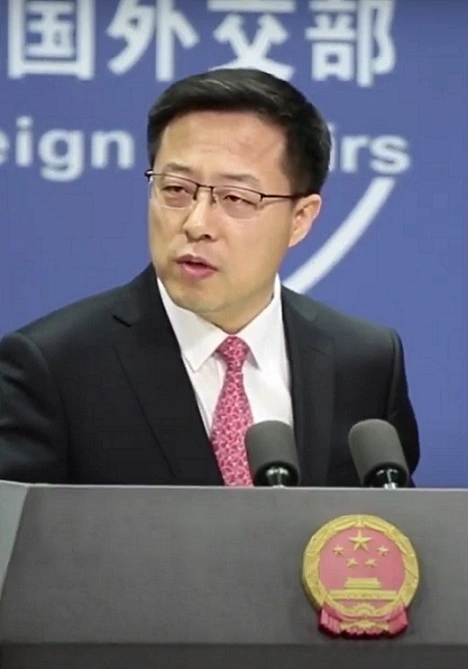
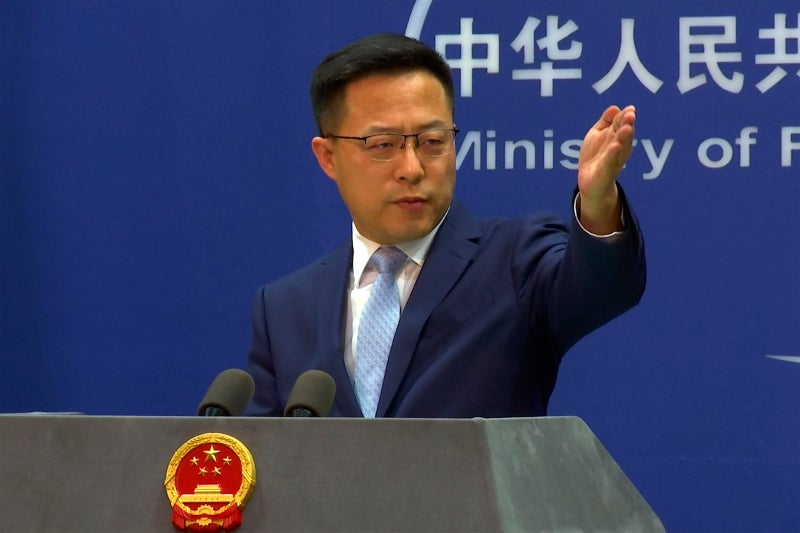
"China celebrates the election of President-elect Yoon Seok-yeol as South Korea's new president," a spokesman for China's Foreign Ministry said at a regular press conference on Tuesday. "We hope to promote healthy and stable development of bilateral relations with South Korea."
Contrary to the official stance, Chinese foreign policy experts are paying keen attention to what kind of policies Yoon will take when he mentioned China's strong opposition to the deployment of additional high-altitude missile defense systems and the quad.
Mainstream Chinese media, including Xinhua News Agency and CCTV, introduced Yoon's thoughts on "developing mutually respectful Korea-China relations," but the network of patriotic Internet media said that Yoon is considered "Korea's Trump." Chinese media "Peng Peng" said that President-elect Yoon is advocating strengthening the Korea-U.S. alliance, and introduced the analysis of Professor Wang Xiaok-ku of Jilin University that "Korea-China relations will face a relatively big challenge in the future."
Cha Hull, secretary general of the Center for International Public Opinion Research at the Chinese think tank, told the Dong-A Ilbo, "If Yoon joins the Quad, the relationship between Korea and China will deteriorate further than the THAAD situation." Cha said, "Third was a missile threat to North Korea, but Quad clearly intends to target China. If it is decided to join, China will impose strong sanctions such as restricting South Korean companies' access to the Chinese market and suspending trade." He also said, "With China set to form a new leadership at the 20th party convention this fall, the check on the public will be accepted as an attempt to obstruct and destroy it."
Former Global Times editor Hu Jintao pointed out on his social media that "Korea's trade with China is larger than the combined trade with the U.S., Japan and Europe," adding, "There is a possibility that Cheong Wa Dae will take a big step to reverse Korea-China relations."
Source of quotation:
I'm participating in the ranking.Please click and cheer for me.
What do the People's Liberation Army think of U.S. aircraft carriers and landing attack ships?
Since the inauguration of the Biden administration, the U.S. has not only put pressure on China to restrict support for Chinese companies, but has also frequently dispatched military aircraft and warships to China to provoke them.
According to the Global Times, the U.S. has deployed the aircraft carrier Carl Vinson, the landing attack ship Esax, and the U.S. landing attack ship U.S.aircraft carriers Lincoln and Reagan.The Ohio-class strategic nuclear submarine Nevada also made an unusual appearance at a U.S. naval base in Guam.
It is unusual for the U.S. to deploy so much military force around China, giving the impression of dignity.Professor Wei Jung-woo of the Center for American Research at Fudan University said in an interview, "The U.S. is sending strategic nuclear submarines and aircraft carrier warships to the Indo-Pacific region to demonstrate its "power" and exercise military deterrence."
The U.S. is not the only military power in the world, but the U.S. is wrong in targeting China.Defense Ministry spokesman Oh Gyeom explained at a regular briefing on January 27 that the PLA's military training in 2022, emphasizing the need to strengthen military training and strengthen enemy suppression training and maintain full-time standby.We will accelerate the integration of training and practice so that we can fight at any time."
The behind-the-scenes stories of "the front line of military struggle" and "fight the enemy and train " are clear.The Global Times quoted an analyst as saying, "There have been experts so far."Despite the fact that the PLA took advantage of the opportunity to train against foreign troops, many netizens still regard it as "respectful."However, it has been confirmed that the Liberation Army is "using foreign troops to train."The U.S. did not expect such provocations around China to be the best training partner for the Liberation Army.This is to make up for the lack of combat experience.The U.S. is really shooting itself in the leg.
It seems that the U.S. military is a practical training partner for the People's Liberation Army's lack of practical experience.I don't understand what it means.
Will Ethiopia's default be the end of African investment? Debt trap derived from One Belt, One Road.
China's One Belt, One Road initiative is set to go even further down the road after Africa's Ethiopia defaulted on the 2nd, unable to pay interest on its debt due in December. The countries circled on the map in the image are the countries where China is primarily investing. Ethiopia, which defaulted this time, is marked in red. One Belt, One Road is a route south to Italy in Europe, but Italy has announced its withdrawal from One Belt, One Road. This is the departure of the western base. Where is Kitaji's base? It is now Kiiv, the capital of Ukraine, which is currently at war.
Yellow countries are those with excessive debt to China. Includes Sudan and Somalia. These are the countries along the Suez Sea, including Ethiopia, which follow the Suez Canal, and China was trying to gain control of the sea route to the Mediterranean Sea. The rationale is simple: once the One Belt, One Road project starts, we can make a lot of money, so why not borrow money and prepare?
South Africa has the highest GDP among African economies, and it can be seen that the countries on the land route to South Africa are also trying to keep it in check. Countries other than the ones circled account for 36.9% of China's investments in Africa, so it is spreading money to almost all countries. The purpose is to buy votes from the United Nations. African countries account for approximately 28.5% of the votes in the United Nations. This is what is behind China and the West, dismissing it as a minority opinion.
This is actually related to the Taiwan Strait issue. Mainly African countries support China's "one China principle." Africa does not want to get into trouble with its creditor country, China, over a faraway island with which they do not have any exchanges.
If the countries along the Suez Sea default, the Belt and Road initiative will end for Africa.
The acquisition of African countries by the world's underground financial institution AIIB is China's national strategy.
AIIB is the world's black finance. Lending money to developing countries to realize OBOR. They provide funds that cannot be repaid, and when they are unable to repay, they seize the country's ports and other facilities. If OBOR is realized, the countries in the area will become rich. That's why it's better to borrow more and more money.
With this financing, China bought up votes in the United Nations, including African countries.
Originally, the African continent was divided into two colonies, British and French, and the British Commonwealth and French Community held the vote in the United Nations, but what is the situation like now? OBOR is China's national takeover strategy.
Communism views capitalists and managers as enemies. Workers become subordinate to capital, and capitalists who acquire large amounts of capital become figures that shake up the nation. Therefore, Chinese companies are controlled by the state as state-owned or semi-state-owned.
In modern China, the state is the capitalist. They invest in domestic and international development in the name of investing in the region and the nation.
If you look at the fact that they are subjugating developing countries to capital, they are essentially no different from the capitalists they see as their enemies.
In fact, it's even worse.
The Last Emperor who appeared at the Tokyo Trials The last emperor of the Qing Dynasty and the first emperor of Manchukuo looked at the times.
The Last Emperor appeared at the Tokyo Trial
The Xinhai Revolution was a Chinese revolution supported by Japan
A revolution that had no choice but to join forces with the old dynasty forces
Russia's hand extended to the continent and peninsula
The idea of harmony between the five tribes of Manchukuo
The last emperor of the Qing Dynasty was Aixinjueluo Puyi. He was also called the Last Emperor and appeared at the Tokyo Trials. There, in front of GHQ, he praised Sun Yat-sen's Xinhai Revolution as an innovative move for China, and said that the Qing bureaucracies at the time were deeply corrupt.
The Xinhai Revolution was a Sino-Japanese joint revolution that was supported by important Japanese figures to modernize China under the rule of the former dynasty. Sun Yat-sen is Sun Yat-sen. Nakayama is a Japanese name, and it was the name of his time in exile in Japan. Puyi understood this very well.
Manchuria was a territory of the Qing Dynasty that Russia came to take over. The Qing Dynasty was a Chinese dynasty founded by the Manchu people, that is, by Puyi's ancestors.
The Xinhai Revolution had to rely on Yuan Shikai's help to suppress the Beiyang warlords, and it cannot be denied that it was a half-hearted revolution, so Puyi's conditions of residence in the Forbidden City were revoked and he was exiled.
The conflict between Russia's interests in Manchuria and the conflict on the Korean Peninsula progressed simultaneously. Russia thought it would be a good idea to colonize China, the Korean Peninsula, and Japan in the same way as Northeast Asian nations.
The Russo-Japanese War not only stopped the Russian colonization of the Korean Peninsula, but also eliminated Russian interests from Manchuria and led to the establishment of Manchukuo. Puyi then became the first emperor of Manchukuo.
Puyi, a Manchurian, was expelled from the Forbidden City and ascended the throne again in his homeland. Many workers came and went from the Korean peninsula to Manchuria, and many people from the Korean peninsula immigrated to cultivate the fertile land of Manchuria. Manchukuo's spirit of ``Five Tribes Harmony'' is an ideal that was built on the reality that these ethnic groups coexist: Japan, Korea, Manchuria, Mongolia, and the Han Chinese.
It is said that Japan was carrying out plunder and genocide on the Korean Peninsula. It's strange.
Both state capitalism and communism have failed in China - Unemployment rate continues to increase.
The reason why it's funny that the number of unemployed people in China is increasing is because China is a socialist and communist country. Communism rejects capitalists and defines them as the root cause of social evil that exploits people. The state confiscates the produced goods. In other words, the state controls businesses and other things that produce social benefits. Even land is not private property. The state distributes the income generated from this. Therefore, the governments of communist countries have tremendous power. Because there is only the nation and the people.
Capitalism has a completely different structure. Based on a free economy, free competition produces people who drop out and become unemployed. To prevent this, we will reduce the unemployment rate by increasing new employment. To achieve this, it is necessary to promote industry and develop new fields. Viewed in this way, both communism and capitalism have one thing in common: the economic policies carried out by the state boil down to employment policies. Companies seek sales, but the nation seeks to secure employment for all its citizens.
In that sense, communism operates from a system design that does not inherently create unemployment, whereas capitalist countries, on the other hand, have a system design that creates unemployment, and fill it with economic growth and employment policies. That's what it means.
So why is there so many unemployed people in China? In capitalist countries, when the economy is in decline, the only way to reduce the unemployment rate is to foster industry and increase employment, but communist countries must have a system designed and operated in which the state forcibly distributes goods.
In other words, the original distribution is not working. Or, vested interests have increased and they cannot control it, and communism is no longer possible. And as a result of continuing something like state capitalism, all of these things are failing.