The new President Yoon Seok - yeol will be confused by many obstacles to its government.The general election will be held in 2024.
2022-03-10
Category:South Korea I'm participating in the ranking.Please click and cheer for me.
The new government begins in a twisted state
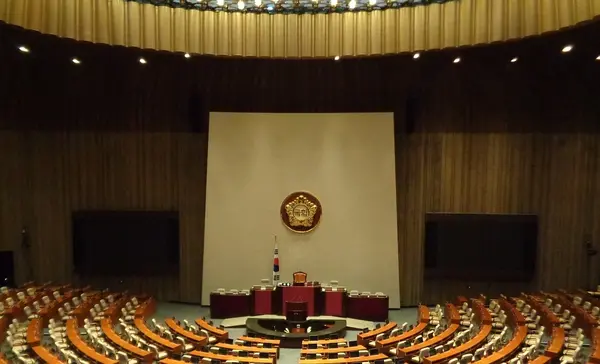
Yoon Seok-yul, the president, will be worried about the distortion with Congress.The Democratic Party which is ruling party has 172 seats (58.31 percent).It is still difficult to determine how the president can implement his policies in this power map.If you look at the presidential authority of the Korean Constitution, there are Articles 53, 73 and 74.Article 73 is the authority to sign diplomatic treaties and Article 74 is the command of the military.Article 53 provides the right to request reconsideration of a parliamentary resolution.Article 49 states that the bill will be approved by a majority of lawmakers and a majority of those present, but if the president requests reconsideration, it will require a majority of attendance and a 2/3 votes .If the figure is to rise from 58.31 percent to 67 percent, the ruling party will have to add to win 25 votes in favor.
Will the full launch be after 2024
The ruling party's bill is likely to be rejected if it is returned.However, since this is a request for reconsideration of the bill already approved in Congress, the bill submitted by the opposition party "People's Power" is likely to be overthrown by the ruling party in Congress.In other words, Yoon will have to wait for the 2024 general election to take effect.Before that, various bills could be rejected by Congress, and the Manifesto incident could be eliminated.In this environment, diplomatic rights such as strengthening the ROK-U.S. alliance may be exercised to sign treaties or agreements.
Prime Minister Kishida is also eager to improve relations
Yoon Seok-yeol is also eager to improve relations between Korea and Japan.In response, Prime Minister Kishida said, "It is important to communicate closely with the new president and the new administration in order to restore sound relations based on Japan's consistent position.I want to see the new government's movements in the future and talk to the new government."Yoon Seok-yeol said in her manifesto, "Japan's apology and compensation are the prerequisite for improving relations between Korea and Japan," drawing attention to future developments."
The presidential election that divides the country
In any case, he won the presidential election, but the difference in votes was less than 1 percent, 0.73 percent, and half of the people supported the opposition candidate.
POINT It is difficult to determine how far policies can be implemented with presidential authority alone.Anti-Japanese forces are still strong.
I'm participating in the ranking.Please click and cheer for me.
[Korea] Unable to accept the fact that the Rising Sun flag was saluted at the naval review ceremony, he started saying that it might not be the Rising Sun flag.
Ship review ceremony attended by South Korean military for the first time in 7 years
A disturbing debate erupts
If it's not the Rising Sun flag, don't yell from the beginning
The South Korean Navy participated in Japan's naval review ceremony for the first time in seven years. Attention was focused on whether or not he would salute the Japanese naval ship holding the Rising Sun flag, and it appears he did so. This is the minimum international ritual required for a ship review ceremony. Do Koreans salute the Rising Sun flag? He's a traitor. There are a lot of criticisms like this, but if that's the case, then you should just not participate in it in the first place.
This is the first time the South Korean military has attended a Japanese naval review ceremony since 2015, during the Park Geun-hye government. There are other completely unbelievable discussions taking place in South Korea. The Rising Sun flag of the former Japanese military and the flag of the Japan Maritime Self-Defense Force are very similar but slightly different, so there are opinions that this flag is not the Rising Sun flag, and opinions that it is the Rising Sun flag.
In other words, on the premise that he had to take part in a naval review ceremony and take a salute, he said in frustration that if he looked closely, it might not be the Rising Sun flag. Have they forgotten that they have repeatedly complained that the crab pattern on the wrapper of Burger King's ``Snow Crab Whopper'' is the Rising Sun flag?
Anti - Korean sentiment in the world
When comparing data from the BBC on positive and negative impressions of Japan and South Korea, a surprising number of countries have a negative impression of South Korea (Reference wiki)
Japan has been at war with China in the past, so we can predict China's feelings towards Japan, but what exactly is South Korea like? Regarding China's sentiments toward South Korea, relations between China and South Korea deteriorated in 2016 when South Korea decided to deploy THAAD, but even if you look at domestic surveys conducted before then, it appears that China's reputation towards South Korea was quite unfavorable.
2007 "Xinhua News Agency" survey results: South Korea ranks first in "neighbors I don't like"
2007 “Tengai Community” survey results. ``Most hated country'' South Korea ranks first
2009 “Global Network” survey results. 94.6% of respondents said they did not have a favorable impression of South Korea.
It has long been pointed out that anti-Japanese campaigns around the world are a strategy to tarnish Japan's image, given that Japan and South Korea have similar industrial structures in the face of global competition.
But when you look at the data... In the first place, isn't the idea that one benefits by degrading others itself wrong?
Candidate Lee Jae - myung said that America was to blame for the division of the Korean peninsula - a victim mentality lacking in historical understanding.
What is this person saying? South Korean presidential candidate Lee Jae-myung told U.S. Senator Jon Ossoff that the Korean peninsula was divided without Japan being divided. It is America's fault that the Korean peninsula was divided into north and south. On top of that, it's a statement that says Japan should have been divided.
Losing a war does not always result in division. The former East and West Germany was divided into East and West by the socialist Soviet Union and liberal countries. Since the Soviet Union was largely responsible for Germany's defeat, the Soviet Union gained control of Eastern Europe, and Germany itself was divided into East and West. In multilateral wars, when the victorious nations were unable to come to terms on their merits and interests, the method of partition was adopted. Germany is a perfect example.
So what about Japan? Although it is still a multilateral war, Japan has won against all Western countries except the United States. Only America lost. The Soviet Union had nothing to do with the Japan-Soviet Non-Aggression Pact. The Soviet Union entered the war on August 9, 1945, just before the end of the war. How could the Soviet Union claim its interests against the United States?
So why did the Soviet Union claim interests in the Korean Peninsula? This is said to have been determined by the Yalta Secret Treaty, which determined the division along the 38th parallel. The question is at what point in time should a return to the status quo be made, based on the principle of restoration to its original state in post-war settlements. At the Yalta Conference, Roosevelt, Churchill, and Stalin discussed how to deal with the aftermath of World War II.
The fact that the San Francisco Peace Treaty recognized the return of Taiwan dates back to the Sino-Japanese War. On the Korean Peninsula, Gojong, the Emperor of the Korean Empire, negotiated with Russia to sell the interests of the Korean Peninsula. The Soviet Union built the transcontinental railroad and began colonizing East Asia. The theory is that if Japan had not interfered in the Russo-Japanese War, the Korean Peninsula would have belonged to the Soviet Union. In other words, they are claiming rights dating back to before the Russo-Japanese War.
Why is present-day South Korea a democratic country? This is based on the premise that the Korean Peninsula belonged to Japan, and it was the United States that forced Japan into defeat, so the United States claimed its rights. Therefore, Korea came under the control of GHQ. Based on this premise, the 38th parallel was established as a compromise line with the Soviet Union, dividing the country into north and south.
[Korea] A major failure in the nuclear phase - out policy highlighted by the rise in electricity prices - Passing the blame on to the people and giving them cold water.
South Korea will raise electricity prices
Korea Electric Power fell into a large deficit
Moon Jae-in's obvious mismanagement
Is the Fukushima prefecture product a commotion to distract people?
Countries with anti-Japanese spinal reflexes
The day you regain your composure
The South Korean government has decided to raise household electricity rates by 5 won per kWh starting in July. This year's additional measures are expected to raise prices by about 15%.
KEPCO posted an operating deficit of 5.86 trillion won last year, the largest in its history. The deficit in the first quarter of this year was already 7.8 trillion won, and unless the tariffs are raised, the annual deficit is expected to reach 20 trillion to 30 trillion won. Therefore, the idea is to transfer that deficit to the people as usage fees.
The Moon Jae-in government is being held responsible for its policy of ``phasing out nuclear power without increasing electricity rates.'' KEPCO, which had a surplus of several trillion won, became a loss-making company under the Moon government. During the five years of the Moon administration, KEPCO's debt increased by 41 trillion won. There are reports that if we phase out nuclear power, electricity costs will have to rise by 2.6% every year, and by 40% by 2030.
Korea Electric Power is South Korea's public power company. Japan's ban on importing seafood from Fukushima, the release of treated water into the ocean, and the controversy surrounding athletes' meals at the Tokyo Olympics are all efforts to cover up the failures of energy policy under the Moon Jae-in administration and distract the public. It looks like it was a festival.
They completely ignore scientific evidence, create sensationalism, and link it to anti-Japanese sentiment. When this happens, the Korean people lose their cool and become overheated. This is the result of anti-Japanese education, and is like an anti-Japanese switch that the South Korean government often uses.
The anti-Japanese mood seems to have eased somewhat with the arrival of the Yun Seok-Yeong administration, but will the public bear the burden of the Moon Jae-in administration's failures in energy policy, which will further dampen the anti-Japanese fervor? Regarding the causal relationship between cause and effect, in Korean society the problem shifts to Japan. Japan has nothing to do with the failure of energy policy. Even if people say things have calmed down, I feel like it's already too late.
Catch - all regulation and its contents Even though South Korea was a white country, I could not understand its meaning.
The Wassenaar Arrangement is an international agreement regarding the export control of conventional weapons, with which 42 countries, including Japan and South Korea, have concluded an agreement. Based on this premise, Japan will introduce catch-all regulations, and will notify the Minister of Economy, Trade and Industry and receive permission when exporting cargo or providing technology that may be used for the development of weapons of mass destruction or conventional weapons. I made it mandatory.
Group A: 26 countries (white countries) Group B: 6 countries (including South Korea) Group C: countries that do not fall under A, B, or D Group D: countries under the UN arms embargo ・Countries of concern designated by regions and exporting countries
The above framework is determined at the discretion of the exporting country from the standpoint of national security. For this reason, Japan is constantly calling for a "review of export control operations." South Korea claims that Japan imposed export controls this time, but Japan has simply reviewed its operations, and as long as the prescribed procedures are followed, exports will continue as before. It's been two years and I still don't understand this. On the other hand, if we were a white country without understanding this basic thing, it would be even more frightening. Do they think they were put in Group D? Group D is currently subject to export restrictions from Japan.
Group D consists of 11 countries, including Afghanistan, Central Africa, Democratic Republic of the Congo, Iraq, Lebanon, Libya, North Korea, Somalia, South Sudan, Sudan, and Iran, a country of concern.