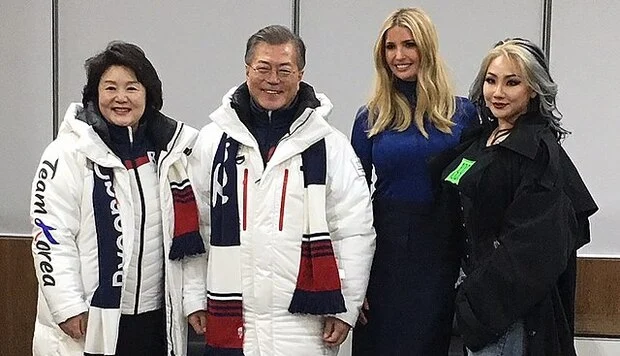
Leaders Participate in the Olympic Opening Ceremony - Prime Minister Abe Participated for the Athletes and Moon Jae - in Used for Political Use
2021-07-12
Category:Japanese comfort woman problem I'm participating in the ranking.Please click and cheer for me.
Former Prime Minister Abe participated in the opening ceremony despite opposition.
At the time of the Pyeongchang Olympics held in South Korea, Moon Jae-in had already spoken out about the invalidity of the comfort women agreement, and in Japan, there was much domestic public opinion against Prime Minister Abe's participation in the opening ceremony of the Games. However, it was thought that Prime Minister Abe would not participate, but Prime Minister Abe announced his intention to participate. The reason was that ``I had to participate as the country's top leader in order to encourage the Japanese national team players.''
South Korea intends to participate in the opening ceremony and do business with us
I have seen Moon Jae-in in this sense, and he is truly a disappointing person. The South Korean athlete did not even know whether his country would participate in the Tokyo Olympics until just before the Olympics, and his argument that he might boycott was so lame that it was dismissed by the IOC. As for Moon Jae-in's participation in the opening ceremony, it appears that he was trying to make a deal until the very end, unilaterally offering a deal in exchange for a summit meeting.
Who is using the Olympics for politics?
South Korea has been the most sensitive to the political use of the Olympics, and appears to have criticized Japan at every turn at the national level. From the perspective of Japan, the South Korean athletes who play the leading role in sports tournaments are nowhere to be seen, and it appears that Moon Jae-in, far from using the Olympics for politics, seems to think that the Olympics themselves are a political venue.
I'm participating in the ranking.Please click and cheer for me.
Japanese Military comfort woman recruited through a newspaper contest. There are many questions about forced arrests from a necessity point of view.
The most questionable point is whether forced arrest of Japanese Military comfort woman was necessary.Lee Yong-soo, who is said to be a former Japanese Military comfort woman, said that the sex industry exists in modern countries and Japan, and that the balance between supply and demand seems to be balanced.In other words, the percentage of men who seek this and women who provide services as a profession.How about in Korea?It is not a situation where people should be forcibly taken away even if they omit ethical issues related to sexual morals.By the way, Japan's unemployment rate stood at 2.8 percent in September.
At that time, many people on the Korean Peninsula were too poor to find jobs, but the unemployment rate dropped dramatically due to Japanese investment, and Joseon itself was surprisingly modernized and developed.Japan was never rich during the war, but men would have to hire them first to get a job.Are there more women who need jobs financially than now?The proportion of men and women after birth or in nature is about 1:1 .It's a simple arithmetic problem.
Japanese Military comfort woman is open to the public through newspaper advertisements, as left as data from that time.And prostitution itself was legal under the laws of the time.In addition, they are paid several times as much as college-graduated men.That seems to have gathered enough people.There are many questions as to why 300,000 people were forcibly taken away.
At that time, Japanese Military comfort woman was paid a lot of money, and when I returned to Korea, I got enough money to buy a house in just about two years.
What is the main purpose of the comfort women agreement? The purpose is for the Korean side to establish a foundation for reconciliation and resolution - South Korea does not understand the main purpo
I don't understand anything about this article (below).Apparently, the former Japanese Military comfort woman refused to receive 1 billion yen donated by Japan in the 2015 Japanese Military comfort woman agreement, so the Korean government donated 1 billion yen to establish a gender equality fund.
In the first place, the Moon Jae In administration and Korean public opinion have been excluded, but the Japanese government has not donated 1 billion yen directly to the former Japanese Military comfort woman.The South Korean government has set up a foundation to support the former Japanese Military comfort woman and provided funds for the foundation.The Korean government's activities and foundation will settle the dispute with the former Japanese Military comfort woman.Since it was a public interest foundation, it would be good to raise new public works projects and funds through the foundation's activities and increase the amount of funds to solve the problem.Japan and South Korea agreed on the Japanese Military comfort woman agreement.The fact that the former Japanese Military comfort woman refused to accept the 1 billion yen donated by Japan itself is contrary to the intent of the Japanese Military comfort woman agreement.
Moon Jae In has dissolved the Reconciliation and Healing Foundation, and one billion yen has not been repaid to Japan, and it has reportedly invested one billion yen in establishing a new Gender Equality Fund.In any case, it is clear that the South Korean government will take the initiative in solving the problem.
[2015 Japanese Military comfort woman Agreement]
Japan side:
(2) Based on this experience, the Japanese government has taken measures to heal the wounds of all former Japanese Military comfort womans based on the Japanese government's budget.Specifically, the Korean government will set up a foundation to support former Japanese Military comfort womans and use the Japanese government's budget to fund them. The two governments will cooperate to restore the honor and dignity of all former Japanese Military comfort womans and heal their wounds.
2. South Korea side:
(1) The South Korean government evaluates the Japanese government's announcement and the measures announced in paragraph 1.(2) above, and confirms that the Japanese government and the Japanese government will finally and irreversibly resolve the problem.The South Korean government will cooperate with the Japanese government's implementation of the measures.
Korean anti - Japanese activities taking place in New York: How should we deal with them, as they are so outrageous?
In November 2019, the Korea Liberation Association urged the International Olympic Committee (IOC) to ban the use of the Rising Sun flag at the upcoming 2020 Tokyo Olympics in Manhattan Square, New York, United States. marching through the city.
The person who is kneeling down on the ground is Kim Won-eun, the chairman of the Gwangjukai. It is said that Japan is losing to South Korea's lobbying efforts, but this is the reality. Japanese people are not aware that they are conducting activities like this in the United States, a completely different country, which is completely based on no facts and deviates from common sense.
The Gwangbuk-kai, which refers to independence from Japan as Gwangbuk, is the central organization for anti-Japanese activities tied to the so-called Korean government.
In South Korea, there are many anti-Japanese organizations that receive support from the government.
They proudly print a historical error that equates the Nazis with Japan on flags and march through the streets of New York.
They are using this to appeal to the American people to ban the use of the Rising Sun flag at the Tokyo Olympics, which is another logically bankrupt activity, but they don't care about that.
The Nazis were a socialist party that practiced dictatorship and massacred six million Jews.
Japan's Greater East Asia War was a war of Western colonial liberation in Asia, and the only things Japan has in common with the Nazis are that the enemy was a power that continued to expand through colonial rule, and that they lost the war.
The Japan-German-Italy Tripartite Pact was not about jointly fighting a war, but rather a non-interference pact that stipulated that Japan would not intervene in wars in Europe, and Germany and Italy would not intervene in wars in Asia.
South Korea conveniently cites the Nazis and criticizes Japan. They know very little about the difference between Japan and the Nazis.
The ``Jongdaehyup'' lost its position due to the comfort women agreement - The Japanese and South Korean governments have agreed to establish a foundation.
Private/government debt 254%
Household debt is 104.2% of GDP
Global trend of interest rate hikes
Mortgage reduces disposable income
A traveler who just has bad manners
In a statement distributed in advance of the conference, Professor Ham Joon-ho of Yonsei University Graduate School of International Studies, who served as a member of the Bank of Korea's Financial and Monetary Committee, stated, ``Korea's macro leverage (private and government debt) level has expanded to 254% of GDP. ” he pointed out.
The household debt balance has continued to expand for 16 years, reaching a record high of 1,850.9 trillion won (approximately 176.9871 trillion yen) in the April-June 2021 period. According to a study by the Institute of International Finance (IIF), Japan's GDP ratio was 104.2%, the highest among 37 major countries and regions. Incidentally, the countries other than South Korea are followed by Hong Kong (92.0%), the UK (89.4%), and the US (79.2%).
On the 15th, the Federal Reserve Board (FRB), the central bank of the United States, announced the first major interest rate hike in about 30 years. The policy rate will be raised by 0.75% to a range of 1.50 to 1.75%.
Prior to this, South Korea announced that it would raise its policy interest rate from 1.5% to 1.75% in May. The rate was set at 1.5% in April, making this the second consecutive month of interest rate hikes. This will also be a severe blow to those who are burdened with household debt.
South Korea's per capita GDP is approaching that of Japan. According to the 2021 IMF announcement, Japan's price is $39,340 and South Korea's price is $34,801. However, Japan's household debt is around 66-7%.
Housing loans are the largest component of household debt. The skyrocketing price of land in Seoul continues to skyrocket, forcing many to borrow large sums of money to purchase apartments. As a result, even if GDP and wages rise, most of the money goes toward repaying household debts, resulting in less disposable income. I don't have any money to spend.
Even after salaries are paid, the money goes straight through the tunnel and is returned to financial institutions, where it is returned to the market. This is the reality of GDP per capita in the Korean economy.
As the coronavirus pandemic begins to subside and overseas travel is gradually lifted, travel to Japan is expected to become a boom again in South Korea. It's not that they like Japan. The above reasons are largely responsible for why Japan is chosen as a nearby travel destination.
And just because you come to Japan doesn't mean you have to spend money. There are quite a few groups that find faults, point them out, and complain to each other. It is said that Korean tourists just have bad manners.
Korean group trying to stop the comfort women movement in South Korea The method is to stay up all night and reserve a space first.
Preemption of space for South Korean far-right groups began in May 2020. In the wake of allegations of misappropriation of sponsorship funds by Rep. Yoon Mi-hyang, who served as the president of the Justice and Remembrance Solidarity (a core organization in the comfort women litigation movement), far-right civic groups held a rally in front of the Statue of the Girl of Peace. They began filing reports ahead of the Justice League.
Meeting notifications can be submitted 30 days (720 hours) in advance, but members of far-right and conservative groups are staying up all night taking turns at the waiting area at Jongno Police Station, where meeting notifications are accepted. , the place is taken away every time.
Although it is a primitive method, it is amazing that they are trying to stop the comfort women movement even by staying up all night.
Kang Kyung-ran, head of the Solidarity Movement for Justice League, said, ``Far-right groups are claiming to ``end the Wednesday demonstrations forever'' and have filed a gathering at the same location. She is a prostitute () on a daily basis, and she does not hesitate to say things that insult us.
I have decided to petition the National Human Rights Commission to take urgent remedial measures and investigate the human rights violations occurring at the rally site, as well as to investigate the police who ignore these acts."
The anti-comfort women movement in South Korea is led by far-right political parties and carried out by civil society groups.